Pages

Saturday, 31 July 2010

Secret Garden Party Thursday/Friday: Review

Secret Garden Party has come and gone then, for another year. Sound Screen went, saw and conquered all. Forgive us our indiscretions but as Secret Garden Party aspires to be a festival like no other, we felt it appropriate to, rather than give individual reviews of bands or musicians per se, offer a more lucid account of our weekend’s gardening.

We arrived around Thursday lunchtime and after a brief fumble with our tent, began a once-over of the festival site. First impressions left us wide eyed with wonder: rolling hills and sparse woodland clung around a magnificent lake at the site’s epicenter. A tour of the site only perked our curiosity further. At seemingly every turn, it was noticeably that immense care and consideration had gone into transforming this private estate into an alternate reality. In every nook and cranny was tucked some small beauty, from the matchstick house that adorned the inside of one tree, to the cryptic signposts (“you are now entering a reality-testing area”)that were strewn throughout the site. The overall impression was one of immense vibrancy, the glorious July sun providing the perfect foil for this beautiful place to blossom.

Whilst the festival proper would start the next day, our Thursday was not spent in any state of anticipation. Stumbling upon a museum of curiosities aboard a disused train carriage, we were invited by two dashing chaps in Victorian get-up to bear witness to the shocking power of electric cucumbers. We moved around the site, and happened across the Guerilla Science tent where a seminar on lucid dreaming was happening. The lecturer offered insights into how we can raise our awareness during dream-states, and testimonies from the audience of fellow gardeners attested to the power of the human subconscious. It was noticeable that whilst music hadn’t started on the main stages, a lot of the tents and independently –run venues at the festival were putting on music that begun that evening. On a recommendation, we caught a set from one of London’s most interesting outfits. The Boxettes are a five-piece a-capella girl group, ostensibly led by Female World Beatbox Champion Bellatrix Ehresmann. Theirs was a finely honed set, delivered with precision. It was short, but held the audience captive. Boxettes have an unconventional a capella sound, with tight beatbox work set against dreamy, sundrenched harmonics as each of the girls took turns narrating through melody over the top. Lyrically, their work seemed to focus on classic themes of love and lust, but were retold with a omniscient sense of distance. These were yarns to recount, folk tales of love lost and of self-empowerment, made for recital in a soulful hip-hop. By it’s end, the tent was full and bouncing to every beat and scratch.

Friday came, and with it the first full day of music. We started our day, however, with a swim in the lake. A quick hop off the custom-made ‘wibbly-wobbly’ bridge, and the cooling lake waters provided the perfect start to our day. Onto the music , then! It all started with a dreamy set from Leeds’ Submotion Orchestra. A tight mix of dub-influenced bass and live electronics overhead, it was a relaxed and emotive introduction to the day’s bill. Following their set, the six members of Tin Roots took to the stage and the tempo was raised. Vocalist Ruby Taylor gliding soulfully over her bands’ genre mashing, a style that took in reggae, soul and contemporary blues against an everpresent metronome of hip-hop beats. The lively set went down a treat, and was topped by an inspired cover of Miike Snow’s recent hit single ‘Animal’, here reinvented with trumpets and sax as a bouncy ska number.

On the main stage, pop starlet Marina was entertaining the kids with all of her Diamonds, a rabble of tweens forming a pseudo-pit in front of the stage and gleefully singing along with her. Frankly, this reviewer doesn’t see quite what the fuss was about, but the inclusion of a couple of token pop acts on an otherwise musically sound bill shouldn’t detract from what was an altogether fantastic line up. It’s hard to say whether punters attend Secret Garden Party in any way for the music on show, but the line up didn’t relent in providing wonderfully summery tunes, immaculately performed.

Steve Mason followed, performing tracks from recent solo album ‘Boys Outside’. This reviewer has always had a soft spot for Mason’s introspecting crooning, throughout his career with Beta Band and that affection continues. For me, this set could have lasted forever. Mason was warm, conversational, inflicted with the mood of the occasion. Although his songwriting has never been that musically complicated, this simple craft allows for an enormous outpouring of emotional weight. Closing the set with the rare ep track ‘Walk the Earth’, it was a euphoric ending to a set that many people seemed to genuinely appreciate.

And so we made our way back to the Chai Wallah tent, where accomplished Bristol act Yes Sir Boss were preparing for by far the day’s heaviest set. A fine group of musicians, YSB seem able to draw from a multitude of influences whilst rounding these into an impressively cohesive whole. Their five members, including a two piece horn section, gallivanted through a rousing set which opened with the stomping ‘Christian Soldier’- a ska-influenced rock number that had the entire room pogo’ing. The band were clearly in their stride and enjoying every moment; the interplay between guitarist Luke Potter and bassist Josh Stopford was a fine thing to see, and the audience reciprocated with an outpouring of love. Arguably, though, it was vocalist Matt Sellors who captured the hearts of this captive audience; growling in hisses and fits at the microphone, thrashing at a disheveled guitar, at once both coy and brazen. It was an enthralling set, closed with a monster rendition of their eponymous single- it’s juggernaut riff sending the audience into a frenzy.
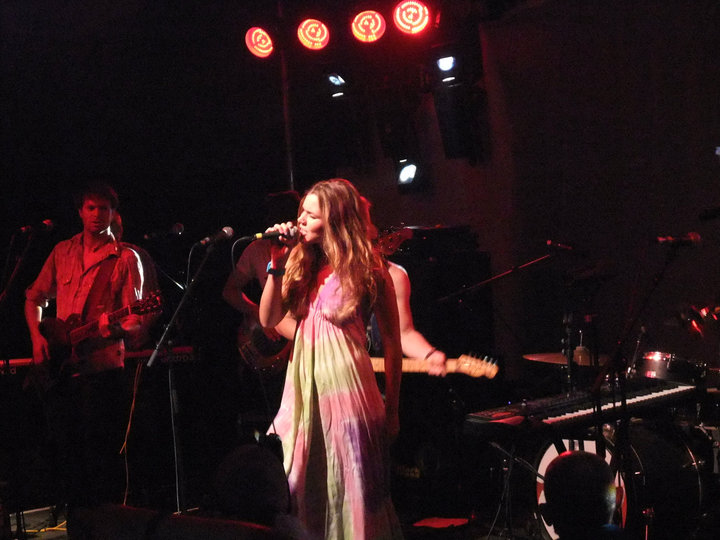
This moment was only topped by what was about to occur. After a short break, they returned, promising a very special guest, and they did not disappoint: R&B singer Joss Stone appearing, clearly beaming, to a rapturous response. Stone and the band (with help from Smerin’s Anti Social Club) whipped through a electric performance o f ’Come Together’, an explosion caught somewhere between the Beatles’ croon and Michael Jackson’s showmanship. This was a fitting end, a euphoric opportunity to ramp guitar amps to eleven- Stone was impeccable, from the moment her mouth opened and that first note resonated around tent. It is a sad irony that in her, we probably have one of a generation’s finest voices, but that too often not been self-evident. Here she was in her element, set against a proper band of rock musicians, making the kind of noise that makes R&B sound like elevator music. This was a ‘festival moment’, there was no doubt about it, the kind of gig that confounded expectations and raised the bar for the rest of the weekend.

Monday, 19 July 2010

Big Boi: Sir Lucious Leftfoot, the son of Chico Dusty: Review

It’s refreshing to encounter such an effortlessly forward thinking hip-hop record as Sir Lucious Leftfoot:The Son of Chico Dusty. Big Boi has made a masterful album of perfectly crafted and hugely inventive pop songs, whilst showing off the full extent of his microphone repertoire. It’s an assured example of what commercial hip-hop should sound like in 2010.


Mm hmmm.

Commercially oriented hip-hop, which is to say- music which embraces the mainstream, has always tread a precarious tightrope of authenticity, from it's knowingly pandering to audience expectation, to confounding it and pushing the culture forward. But whilst the stage has never been better set for rap artists to get their fifteen minutes- too often, the ones that make it have fallen into the former category, only for their original fans to cry "sell out" (read: Dizzy Rascal). Prominent artists have been reduced to bit-part raps on a chart-topping middle-eight (Clipse on Justin Timbalake’s Like I Love You), or the parodic re-performance of nihilistic street-hustling, real or imaginary. That posteuring and game-playing could’ve become an inherent part of the lexicon- of course some swagger is perfectly valid, but not for it’s own sake.

Whilst no serious hip-hop fan could doubt Antwon ‘Big Boi’ Patton’s mic credentials, it’s been a shame that he’s had to live in Outkast compadre Andre 3000’s effervescent shadow. A new audience of casual hip-hop listeners bought the Outkast double album, but only ever spun 'The Love Below', dismissing 'Big Boi's offering as juvenile thug-talk, therein irrelevant to their existences. Rather than comparing the records on merit, Patton was ignored on the basis of an incorrect presumption. But were it not for his bandmate releasing 'Hey Ya!', Big Boi would have been sitting on single of the year for 'I Like The Way u Move'. But with his debut solo album for Def Jam, Big Boi should dispell any of those comparisons. This is his moment, and he knows it.

The record is enamored with the grandiose, but whereas similarly pop-inclined rapper Lil Wayne’s Tha Carter III was a triumph of style over substance, watching it's central performer became more fascinating than listening to his records- Sir Lucious Leftfoot is a collection of wonderful songs, delivered with a flawless consistency- it’s central character only a conduit for the craft.

It’s refreshing that whilst he's no philosopher, Big Boi avoids the trappings of gangsta-nostalgia. Yes, he pays it lip service- but only by indulging it with irony. Predomionantely, it's a relentless flow of puns, aphorisms and word-play. Even on songs like Be Still, where after a minute’s music you can’t really fathom how Patton is gonna find space to rap between the avant-garde beat work- it’s an unwarranted fear. As soon as he opens his mouth, the music instantly twists to his voice, as though there isn’t a beat in the world he couldn’t rap over. His is a dextrose and malleable voice, able to shift and turn in a microsecond. On the carnivalesque Night Night, he seems to invent new ways of rhyming in metre, putting syllables where they just didn’t fit before. Pay attention, and your jaw drops. His flow is playful, unpredictable but engrossing, flirting with rhythm- never staying in a groove for too long. One moment arguing against beats, only to then conspire with them.

"Lucious. Loo-shus. Yeah, that's right!"


Over the record’s 57 minutes, there’s a staggering amount of ideas fighting for competition. Rather than establishing a globe-trotting style akin to Mos Def’s fine recent work The Ecstatic, Patton crafts these into a cohesive whole. The first listen might seem daunting- at any single moment there’s just so much happening. On opening track Daddy Fat Sax, dreamy 80s synths compete with military drums, vocoder samples are twisted, and casiotone glitches fly in the stratosphere. The effect is powerful if completely uncategorisable- it’s ability to effect a feeling of both serenity and momentum at once.

Similarly, after Tangerine’s fuzzed guitar has lulled you into a driven haze, a wild electric lead trades places with a reverb-heavy jazz piano- taking turns to enforce a change on the track’s mood. It’s forever inventive, a trick carried over the 16 tracks, employing both respect for loops and full mastery of both studio and songwriting. The results are dynamic, transformative, joyful songs. Patton just makes it sound easy, an impression that betrays the 3 years plus that went into the record’s production.

You put it on for the tunes; numbers like Shutterbugg and Tangerine showing off the grace of quality instrumentation and bright arrangement- but you stick around for the rhymes. Describing the record as his ‘Luke Skywalker becoming a Jedi moment’, it’s the sound of an enormously talented rapper with years of experience on his peers, knowing that when you’re good- go with it.

Wednesday, 2 June 2010

Secret Garden Party: Preview

As the sunshine becomes an evermore regular fixture in our days, the true meaning of Summer awakens memory and perks excitement in the British public. Yes, festival season approaches fast on the horizon. One might wonder how we got here, from the relative novelty and obscurity of British music festivals a decade ago, to the now seeming ubiquity of the scene. Over five hundred music festivals will grace the fields of Albion this summer, from the mainstream and corporate to the obscure and fiercely independent. A ready-for-use formula of bars, campsites and arenas has rendered the majority of these gatherings fairly homogeneous. That so many of these festivals, as with our clubs and concert halls, are now owned by large entertainments corporations (Mean Fiddler and Live Nation come to mind) only affirms the fear that what was once a unique opportunity for a gathering of communities and artistry, now resembles little more than a weekender experience, flat-packed for the SMS generation. A rotating cast of super-bands embarking on annual global festival tours does little to assuage this creeping feeling; and it's fair to say that many festival goers have been experiencing a kind of existential crisis.


But a growing number of festivals here in our very own United Kingdom are seeking (to coin a recent election phrase) "to do things differently". Of this small but increasing number, The Secret Garden Party is by far the most exciting, rewarding and plain 'out-there'. Imagine a festival where punters were treated not as cattle to be herded in and out of the arenas, but as individual members of a temporary society. A festival where the bands on show are just as excited to be there as you. A festival where the non-music activities didn't feel so 'corporate experience'. A festival where your bars are staffed by bartenders, your beer's a freshly poured one, the food is organic and restaurant standard. I'm barely scratching the surface of this unique, beautiful, often staggering festival.

Since it's inaugural year in 2004, where some 1000 people attended that first and now mythologised weekend- The Secret Garden Party has attracted a cult following. Devotees from previous years return with wide-eyed wonder and eager anticipation. You will know someone who can tell you a Secret Garden Party yarn, usually with glee, recounting the absurd and amazing things they have seen and done in previous years. A previous festival indulged itself by constructing an enormous ship on the lake which makes up the ground's centrepiece. After bands had finished performing on it, at the end of the weekend- it was blown apart in an explosion celebrating the carnivalesque, acknowledging creation and destruction. This ethos of participation in, towards and becoming 'grander events' is central to the Secret Garden Party ethos. Like America's infamous Burning Man festival- an event from which SGP's organisers draw huge inspiration, emphasis is on utter freedom and community-binding acts that bring out the best in people as well as inspiring awe.


And so Secret Garden Party is something of an enigma in the British Festival circuit; for whilst other festivals may entice through the location itself or the quality of the line-up, SGP places the emphasis firmly on those who attend. In their own words "We provide the Garden and plant the seeds, but you nurture its life and allow it to blossom. It is your party – your creative participation allows the festival to rejuvenate & regenerate." Would you ever hear those words eminating from a festival-behemoth like Mean Fiddler? Is it even possible to consider Reading festival 'a garden'? This commendable focus on you the festival goer, you the individual, collectively entails that a sense of pleasant freedom and community is native. An impossibly long list of activities (don't think Butlins), including Giant African Land Snail racing, life drawing, a scientific experiments area and academic lecture theatre- ensure that you are never bored, never drifting off, never thinking about 'heading back to the tents for a lie down'. In fact, if you're that kind of person- Secret Garden Party probably isn't for you. The Rejuvination Field is on hand to cure what ails ye: with a multitude of global massage techniques on hand, reflexology, yoga, even a giant-sized version of the classic board game 'Operation', for when you're feeling yourself again. A conspiracy camp explores debate and conjecture between peers. This year's festival falls on a full moon, so gardeners (as festival goers are lovingly referred) are invited to spend a while howling at the moon, rediscovering our inner wolves. Restuarants with such delicacies as free range guinea fowl and sweet potato dauphinoise. Oh, and lest I forget- if one requires quick but essentially bourgeois transportation across the site- there is of course, the fully working steam train with carriages. And one of the carriages is a club. But when you have eventually tired of the all-night roller discos and you do retire to your tent, a samba band will parade the festival every morning at 10am sharp, ensuring all gardeners are awake and atttentive, excited about the coming day.


With some much going on to become involved and lose yourself in, it's almost forgotten that a large number of very good bands happen to be playing the many stages at Secret Garden Party. Previous line ups have included Phoenix and Jarvis Cocker, and this year's can stand tall: From well-known names such as Mercury Rev and Eliza Doolittle, to upcoming indie star Darwin Deez and the delightful Belleruche. Across 14 stages, all colourfully named (from the Great Stage, the Remix Bubble, to the Where the Wild Things Are stage- where performers play from a wooden tree house)- Secret Garden Party's line up is designed to both please and surprise. "Favourite new band" discoveries are common here; the organisers hand-picked artists who will both fit into and appreciate the festival's aesthetic.


Every year, the Secret Garden Party is themed- and this year is no exception. Previous themes have included the myths of 'Babylon and Eden', 'Past Present and Future' and 'Revolutions'- mandates open to interpretation in one's decor, but promising a host of thematic and unexpected events throughout the weekend. In 2010, the festival will seek "prize open the chinks in man’s most carefully constructed edifice: Reality. The Garden will be exploring the illusions, visions, theories, fantasies, mysteries and legends that have created a rich world between Fact and Fiction." A hugely enticing brief, no doubt- calling to mind postmodernism, solipsism, nihilism, the art of Escher and Dali, Homeric thinking, construction of fictions, retelling of Histories. This year's Secret Garden Party promises a festival dedicated to wonderment, imagination and the impossible. It might be a secret now, but probably not for much longer. It's festivals like this that reaffirm your belief in the central premise: fields, music, people. That simple formula so often spoilt by unthinking corporate swipes, misunderstood by the global festival machine- enacted, for one weekend in Cambridgeshire, to within a whisker of utter perfection.

Secret Garden Party runs from 22nd to 25th July 2010.
Tickets are priced at 142.00 and are available from seetickets.co.uk and secretgardenparty.com
Boutique camping (of which yurts, tipis, centrally heated wooden huts, your own butler, door-men and other luxuries are available) starts at 350.00

Saturday, 29 May 2010

4321: Review

Following the release of 2006's Kidulthood, cinema mythology recounts that writer, director, actor and all-round thesp Noel Clarke was summoned to a meeting where it was put to him that his female characters were 'unrealistic' and 'very negative'. Granted, it was hard to find many positive representations of indeed anyone in that grimy street-yarn, but Clarke was incensed all the same. Compelled into 'speaking to women', Clarke scripted an ambitious and heavily stylised adventure-thriller focusing on the individual and collective misadventures of four young, aggressively empowered female friends. It's a whirlwind ride, flitting between London and New York as the girls get caught in the midst of an international diamond heist. The pace is relentless from the off and an expressive edit maintains this dirvish- but 4321 is ultimately a triumph of style over an appalling lack of substance.

Throughout each of their three days, our four leads experience all manners of impediments: back-story sourced from family issues, self-esteem, boyfriends and depression. Explication is a slow burn- due to the film's 'split-narrative' structure: four simultaneous accounts of each girl's story. As such, 4321 is content for ambiguity to enshrine it's character's motivations until it's narrative climax rounds these distinct threads together. Cassandra (Tamsin Egerton), a glamorous and suitably wealthy pianist, flies to the Big Apple in search of both entrance to a prestigious musical academy and (of far greater import) a mystery internet boyfriend. Shannon, portrayed by the smouldering Ophelia Lovibond, is a exercise in perpetual indie-angst, bearing the brunt of her parent's divorce. Kerrys (newcomer Shanika Warren-Markland) is a feisty and empowered sapphic with street-smarts and guile, but an overbearing family. Finally, Joanne (Emma Roberts) is a unassuming but 'take no shit' American ex-pat forced to begrudgingly wile her life away behind the tills in a convenience store co-managed by Tee (Clarke). You might have guessed: Clarke indulging that same 'sup blud?' line in British "Boyz N the hood" gangsta that he seemingly revels in.


Besides the seeming improbability of these four girls from totally disparate backgrounds and cultures finding common ground and striking up close bonds, there's more than a hint of unrealism both in the construction of their characters and in their respective portrayals. With exception of Lovibond (who could teach Twilight's Kristen Stewart a thing or two about pent-up trauma), the acting on display is deeply inexpressive. But Egerton looks fantastic as Cassandra and makes no bones in getting her kit off for a wonderfully voyeuristic camera (at the same time, masterfully, as the film offers a critique of voyeurism). Indeed, 4321 resonates with sex appeal- the pumping soundtrack and heavy edit complement both the casting and cinematography. Perhaps the whirlwind pace of the film's edit contributes, but little time is allowed for resonance to set in. In one particularly troublesome scene, Cassandra comes-to after being drugged in New York, her possessions stolen- and there is the briefest of instants between her tears welling up and her embarking for vengeance. Other films may portray similar scenarios with more sensitivity and grace; in 4321, Cassandra 'deals' by tying her tormentors to a post and kicking them between the legs. It's a literal kind of empowerment at best, most adeptly served through physical retribution. When characters falter, it's simply down to their naivity. And after overcoming adversity, it's all high fives for the girls.

If 4321 is Clarke's attempt at writing for women, it's a profoundly masculine perspective. From its glib recounting of secret abortions (used merely as a plot device) to steamy lesbian sex scenes (made for the DVD 'skip scene' button), there is a real danger that these four girls are merely caricatures spurred on by single moments which are, in Clarke's view, inherent to 'The Female Condition'. To pick out one example, it's a mystery how Shannon goes from one scene in which she very beautifully graffitis a touching ode to her aborted child, to then unthinkingly chasing the affections of a noteworthy playa (think N-Dubz Dappy). These two moments, frankly, just don't add up- and sadly leave each character feeling disappointingly one-dimensional. There's enough detail inherent in these characters to merit more reflective portrayals, yet 4321 skims the surface. "Oh, damn- you had an abortion? Riiiight, I get it now".

Similarly, whilst the narrative arcs around an ambitious format (that four-strain overlapping narrative split) and attempts to carry it through with well-edited montages which recount each girl's 3 days before moving on to the next- it's a fairly damp squib when one considers the implausibility of the plot itself. This narrative style, if nothing else, is a way of drawing intrigue into a story where little exists. However, rather than offering the kind of postmodern storytelling made hip by Christopher Nolan's Memento, Noel Clarke here provides nonlinearity for the Hollyoaks generation. It's not that Clarke holds back story elements for the sake of plot, rather that the film's narrative technique justifies itself by holding these facts back. This is a catch 22 situation where insistence on editing style has acheived greater prominence than finding the best way of telling a story: sadly reminiscent of Kiera Knightley's post-production wetdream Domino. Whereas classic nonlinear films like The Usual Suspects hold out it's big reveal after asking an initial question (who is Kaiser Soze?) and offer limitless re-viewing potential (embedded clues!), 4321 merely exhausts you by it's conclusion.

4321 is then, a quite remarkable film, despite- perhaps because of- it's vapid unremarkable-ness. Aspiring to create a stylish and zeitgeisty piece of contemporary British cinema, Clarke has instead created the polar opposite: a tragically missed opportunity for him to write compelling female leads. A patronisingly comic storyline with worryingly lifeless caricatures- the whole thing carried forward by insistence on style for style's sake, the director seemingly convinced of both the film's authenticity to it's subject and it's relevance and importance in a wider cultural context. 4321 deals with serious issues with all the profundity of a Skins episode. Whilst it may provide light entertainment, a few giggles (the rolling news graphic that Chelsea FC had been liquidated) and keep your interest up much in the same way sitting in front of E4 on a Sunday morning would- it's an ultimately tiring journey that doesn't go anywhere you hadn't been before.

Sunday, 16 May 2010

Bad Lieutenant Port of Call New Orleans: Review

With his latest foray into dramatic storytelling, Werner Herzog seems intent on both insulting tradition and confounding expectation. Port of Call is, in essence, a narrative refranchising of the cult 1991 Abel Ferrara movie Bad Lieutenant; a guilt-trip in which Harvey Keitel's morally bankrupt policeman indulges most of the film by destroying his own humanity against a backdrop of Catholic imagery. Herzog's reimagining has irked many- Ferrara included, exclaiming that "It's like when you get robbed. It's just a horrible feeling and I don't understand why they would do it" - but perceived intellectual piracy aside, there is a great deal that is original and distinct about Port of Call.

This is a reimagining, rather than retelling- in the vein that one James Bond film does not replace a previous- instead, you take that central character and immerse them in new situations. With a degree of arrogance, Herzog claims not to have even seen the original. But rather than merely shifting the incidentals (Port of Call is set in a Katrina-stricken New Orleans, rather than Ferrara's New York) Herzog offers a tonally distinct Bad Lieutenant- and whilst the 1991 original can be considered a somewhat morbid portrayal of moral denigration, Herzog presents here a black comedy of some considerable whimsy.


In the role of our bad lieutenant, Terrence McDonagh- Nicolas Cage is a revelation. Following his award winning turn in 2002's Adaptation, you could argue that Cage made some bad decisions and was thrown into thesp's wilderness. The abysmal Wicker Man remake compounded the perception of Cage as a cult joke: comically overacting and doomed to be typecast in 2nd rate thrillers. But Cage is back and more himself than ever; last year's criminally underrated sci-fi opus Knowing and his star turn in surprise-film-of-the-year candidate Kick-Ass proudly showing off all that make Cage an uniquely engrossing force. Port of Call is a foil upon which his neurosis are allowed to shine, a script seemingly deigned for his rendition. McDonagh is one corrupt murder po-lice; hopelessly addicted to gambling, drugs, sex and violence: It's hard to imagine anyone else filling this role so adeptly.

Port of Call ambles through it's 2 hours with pace and intensity, never losing momentum or direction. It's comic overtones are reminiscent of the Coen brothers work, but rather than derive humour from plot- Herzog here employs character as the focus. Like much of Herzog's dramatic work, Port of Call works through the exposition of character. This is especially evident in the director's infamous and fraught collaborations with actor Klaus Kinski; a relationship that Cage is quick to allude to. As Herzog instilled in Cage throughout shooting, McDonagh exists through and revels in 'the bliss of evil'. The relationship between director and actor is never more apparent than in the scenes where Cage is given reign to fly off the handle and improvise. In one scene (no doubt to be revered in the expanding Herzog mythology), Cage unexpectedly pulls a gun on two elderly women and treats them to an ad-libbed shower of expletives. They were genuinely frightened.

It's this taught relationship between comedy and repulsion along which the central performance is posited. Although the film is overtly comedic in places, dialogue and situation combining to revel in the absurd (a masterfully surreal scene in which a whacked-out McDonagh hallucinates crooning iguanas at a crime scene comes to mind) - Cage was careful not to fetishise or glamourise the protagonist's indulgences. Extensive research into addict's tics (lip smacking, fast talking, poor attention spans, slurred speech) empowered Cage to portray the ugliness of rampant smack, coke and crack addictions- but this is in no way a treatise on drug-use. McDonagh is a maverick, a grotesque joker that, whether you like him or not, gets results. The pervasive horror of his descent is instilled as much to round his character with a sense of realism as it is to provide by-turns comedy. Much in the same way that Chris Morris' Four Lions employs absurdity to hack at the truth of the matter, Cage's over-the-top performance works in favour of a profound realism.

I found it hard to hold any firm expectations before seeing Port of Call. The combination of cult director, enigmatic lead, the controversy surrounding the 1991 original, the choice of politically 'in-vogue' New Orleans as location- all seemed to contribute towards a sense that 'this is going to be great'. And, in truth- Port of Call doesn't disappoint. It's a deeply engrossing character-led film that shirks the moral quest of Ferrara's original in place of a realist black-humour that is as relentless as it is shocking, as impressive as it is pitiful. And while it's directed with all the grace and humanity that one would commonly associate with Werner Herzog, it is perhaps Nicolas Cage's finest hour.

Thursday, 15 April 2010

Rainbow Arabia - Kabukimono: Review

It's always warming to discover another band formed of marriage, isn't it? Especially when the group consists only of the married couple, unlike indie mainstays Yo La Tengo or Arcade Fire. In both those groups, extra band members must feel at times like musical gooseberries. But however sweet the back-story may be, making decent music goes a lot further. Like Sonny and Cher (in the happier moments), LA couple Danny and Tiffany Prestons enjoy a natural interplay. Their second EP 'Kabukimono' was recorded in the cracks of a relentless touring schedule, at one point opening for the in-vogue Gang Gang Dance across Europe, and it's a wide-eyed wonder of a recrd- a triumph of technology and worldview. Kabukimono clearly draws influence from subculture- dub, italo and post-punk to name a few- but rather than sounding derivative, Rainbow Arabia artfully weave these elements into a sound which is unmistakably their own.


It's a euphoric and refreshing journey across this record's five original recordings and two remixes. Sharpened drumbeats overlap and clash wonderfully, the deep hits conflicting with staccato beats on top. Tiffany Preston's delivery is inflicted with playfulness and soaked in a controlled reverb. Her melodies are less a narrative focal point for the music and rather a kind of avant-garde complement to it. It's a similar style to Ponytail's caustic frontwoman Molly Siegel- though whilst Siegels rasps are shrill and feral, the vocals here are intoxicated and heady. Preston is clearly mouthing words, but it's hard to tell what they are. Maybe even she doesn't know. Maybe it doesn't matter. The cavernous production on the vocals contrasts with a precise drum sound, spiking guitar work and ever so slightly fuzzed synths in a style which calls to mind the work of Warp stalwarts Broadcast- but Rainbow Arabia 's agenda is more cosmopolitan. The steel drums on 'Harlem Sunrise' provide an easy context, but the record is frequently tinged with globalism. Kabukimono is an intriguing record, representing a real statement of promise. Rainbow Arabia have created a psychadelic and hedonistic dream world rich in colour, depth and most importantly, sound- and it's thoroughly enjoyable.

Sunday, 28 March 2010

Tru Thoughts Funk: Review

Genre spanning Brighton label Tru Thoughts has enjoyed a fantastic eleven years, putting on some of the area's most essential club nights, hosting a killer radio show and of course, putting out records. But whilst a great deal of their roster have left in recent years, signing for American labels like Ninjatune or the larger British label, Warp- Tru Thoughts have kept going, building a formidable catalogue of releases and artists. This is clearly demonstrated on this Tru Thoughts Funk, which pulls in 18 tracks from the label's funk-inflicted artists. There's always a danger of record label retrospective compilations being both self-congratulatory and an irrelevance. Anyone who owns the albums from which these tracks are pulled will find little they couldn't knock up with a playlist, save an out-of-print recording and the almost mandatory 'two original tracks'. But the partisan audience isn't this record's preferred audience; it's raison d'etre instead is to educate the uninformed listener on all that crazy funk thats been happening in Brighton for the past decade. And in this light, Tru Thoughts Funk gives a very decent account.


Production is impeccable (and you'd suspect, digital) throughout. As an aside, it may be that the genre constantly references an age when music was digested on vinyl, I do feel that the polished sound of contemporary recordings does the musicianship a disservice. This is especially evident on some of the record's instrumental pieces- where the urgency of the groove is lost under the weight of 'clean' digital sound aesthetics. Perhaps I just miss the vinyl hiss. But such moments are rare. Opening with the 70s-inspired strumming of the Quantic Soul Orchestra before giving the platform to brightly-voiced soul diva Alice Russel- guesting with The Bamboos, the record shirks instrumental jams between lyrical numbers. Kyle Auldist's 'It's On' is frank, sun-drenched and everso horny. It's one of the best songs on the comp, delivered with insistence and guile. The backing band playing like they mean it, everyone smiles. In moments like this, it's impossible not to start moving, or smiling with them. Tru Thoughts Funk is a hugely enjoyable start-to-finish listen, perfect DJ fodder and a fine testament to the continued success of this Brighton record label.

Monday, 15 March 2010

NCL Freestyle cruising: Review

In the midst of a rather wintery Spring, Handbag.com escaped it all and went cruising around the strait of Gibraltar with NCL. With sunglasses and suntan lotion packed, we were ready to set sail!

NCL is famed for it's 'freestyle' concept, which allows you the freedom to enjoy your cruise as you will. Unlike other cruise operators, there's no enforced dress code, nor are meals and activities at set times. Being on your own schedule is crucial, allowing you to relax and explore the Norwegian Jade's 15 decks of bars, restaurants, nightclubs, pools and spas at your own pace. At first, we have to admit, we found the size of the ship a little daunting- but a little exploring and it soon began to feel like a home from home. Our stateroom came with a fantastic balcony and outdoor chairs. Overlooking the side of the vessel, it made for a beautiful view both whilst at sea and when pulling into port. What better way to relax than cruising in the gorgeous sun off the Mediterranean?

Onboard

Whilst sailing from Barcelona to our first stop in Morocco, we enjoyed the rare luxury of an entire day at sea. And though land was nowhere to be seen, there's simply so much to do onboard that boredom rarely sets in. From the basketball and tennis courts to the video arcades and casino, there's something for all ages to enjoy- and we found ourselves quickly sampling a little of everything. The on-ship theatre offers a range of shows performed at regular intervals and there's even a fitness centre and gym to help you stay in shape. Of course, for those with a slightly less adventurous spirit; the poolside bars and loungers offer a perfect place to escape and soak up the rays with a book and a cocktail. After all this, wind down with a pampering spa treatment in the Jade's luxurious onboard spa and beauty lounge. For the evening's sailing, the Spinnaker Lounge overlooking the rear of the ship offers drink and dancing til the early hours- it quickly became a regular haunt of ours as we danced the nights away to live bands and disco.

The Food

The Norwegian Jade offers 3 food lounges for complementary eating, but also offers a number of specialist restaurants whose chefs offer fine dining and authentic tastes of the world. The French bistro, with it's magnificent original Van Goth, is a sultry and romantic venue with an enticing gourmet menu of grilled escargot, cheeses and the obligatory seafood. Papa's, the Norwegian Jade's Italian- has an atmosphere like no other; the aroma of herbs and antipasti hitting you as soon as you enter. From there it's the Italian tradition of having at least four courses- harder than it sounds! Up a deck, and the Teppanyaki restaurant is an experience we won't be forgetting in a while! Our very own chef prepared an array of mouth-watering oriental meat and vegetable dishes with a skillful acrobatic display in front of our tables. Elsewhere, Cagney's- with it's law-enforcement themed decor (inspired by 80s cop shop 'Cagney and Lacey') is the place to be for an all-American feast. With a steak menu that runs an entire page, ribs, giant shrimp and the most heavenly chips (fried with oyster!) - Cagney's uncomplicated but deeply satisfying menu quickly became a favourite.

Casablanca

After our relaxing 'sea day', we were about ready to hop on land and explore Morocco's second largest city, the romantic Casablanca. Following a five minute drive to the city centre, we were let loose upon this inviting, but disparate city. It's a melting pot of ethnicities and is one of the more tourist friendly parts of the country. Moseying through the narrow streets of markets and cafes, we were immediately struck by the number of cats that live wild there. Nursed and loved by all the locals and fed fish from the evening's catch- cats enjoy the freedom of the city and it's a charming sight if like us, you are an avowed feline-lover. Overlooking the coast is the Hassan II Mosque, the largest in Morocco and third largest in the world, a beautiful and ornate building with wide-open spaces and stunning Islamic patterns adorning every wall and pillar. It's a grand spectacle regardless of your religious persuasion; a magnificent building and space to be in. When visiting the Mosque, as with all ethnic or religious spaces- it's a good idea to respect the local customs, in this case, covering your hair with a veil. But don't feel stifled, this is a great summer look anyway and you wouldn't want to miss out on the majesty of this building.

From there, it's only a ten minute walk to probably the best-known bar in all of Africa: Rick's Place. Lovingly restored to an exact pastiche of the establishment made famous in the 1942 Humphrey Bogard / Ingrid Bergmann film 'Casablanca'- it's a tourist friendly environment to enjoy a bloody Mary and note how Bogard's character never actually said "Play it again, Sam".

Agadir, Taroudant and Tiout

So after sailing again overnight, we docked in the port of Agadir and set off on one of the Norwegian Jade's many 'Shore Excursions' - packaged adventures, if you like. This involved a driven tour of the area with a local guide. Agadir is a popular town with tourists and surfers; it's vast beach and good waves contributing to a chilled-out vibe. Our driver took us first to a mountaintop overlooking the city, with splendid views and the opportunity for camel riding. Then a drive through Morocco's vast countryside, through fields of crops and stopping to see how the local produce of Argan oil is carefully extracted. The Argan trees are everywhere in Morocco, and we stop again to see for ourselves that most mythical of Moroccan sights: goats in trees. Whilst we had heard rumours, we had quietly disbelieved them: however, the sight of a local goatforaging in an Argan tree to get at the fruit toward it's top is an endearing one.

We arrived in the busy market town of Taroudant; it's 16th Century clay walls enshrouding a busy hub of commerce. Taroudant is a fantastic place to shop for authentic Moroccan fabrics and other products- it's winding indoor lanes bustle with activity and we could literally have spent all day there, admiring clothes and adorning ourselves with traditional Berber jewellery.

Another short drive away was the Berber village of Tiout. Berbers are the indigenous people of this region and have their own customs, but like so many indigenous peoples now rely largely on tourism. Tiout is tucked away between mountains and oasis, basking in sunlight and jungle. We were treated to a magnificent Tajine feast before being taken on a bumpy but thoroughly enjoyably donkey ride through the oasis, past ancient ruins and around the mountains- before saying our goodbyes and driving back toward the Norwegian Jade. It's worth mentioning that whilst a great number of Moroccan peoples may offer to help you, take a photograph or offer something- that these people rely on tourism for their livelihood and in Morocco, precious little comes for free. But this in mind, the tourist shots of us riding donkeys and camels were well worth it, after a little haggling down.

Las Palmas De Gran Canaria

Last stop on our jaunt across the Mediterranean was Gran Canaria. Without doubt, the most tourist friendly and 'westernised' of the locations we had visited- Gran Canaria is, at it's core, a resort; and while the island's 800,000 residents live are spread across the now dormant volcanic island in colourful but poor urban housing- the city centre is much like any other. Although the shopping districts allured, we taxi'd past them in lieu of the 'Old Town'- a charming sub-section of the city where traditional architecture and history have stood the test of time. Here, we explored beautiful cathedrals and turning a corner, stumbled across Christopher Columbus' home- now a museum dedicated to his legacy. Once we'd escaped the hubub, our day in Las Palmas was a relaxing one spent strolling around in the sun, helping ourselves to iced creams when the opportunity took us. And as the sun set and the evening drew in, our adventures in the Strait of Gibraltar were coming to an end. Cruising with NCL had offered an intense few days, packed with adventure we'll not be forgetting in a hurry. A few hours flight later, we'd were returned to a country in deep freeze, with only our newly acquired tan as evidence.

Twin Peaks: Season 3?

Twin Peaks was originally intended to run forever like a soap, but producers brought it to an end in series two with a tantalising cliffhanger. Fansites have speculated and a graphic novel was briefly planned but it's unlikely anything will materialise. Still, audiences are pondering: what would happen in a third series? We've been scratching our heads and come up with a few ideas.


Last time we saw Agent Cooper, he wasn't looking so good. He escaped the Black Lodge but is possessed by Bob. With the murder case seemingly closed, Cooper/Bob returns to FBI headquarters and begins committing more atrocities. As noone in Washington would believe in the supernatural, Twin Peaks' vigilante group 'The Bookhouse Boys', led by Sheriff Truman- must discovery the White Lodge (the spiritual realm of 'good') to defeat the demon inside Cooper.

In Twin Peaks' final episode, a reborn Ben Horne admits an affair with Donna Hayward's mother, hinting that Donna is his daughter. It's ambiguous whether Audrey Horne survived the Mill fire, but actress Sherilyn Fenn has stated in interviews that Audrey lived. Rumours abound that David Lynch's 2001 film 'Mulholland Drive' was originally intended to be about Audrey's future, having gone to Hollywood to live her dream as an actress. Donna and Audrey become close friends and, disillusioned with Ben, decide to leave Twin Peaks together. Their paths cross with Donna's ex, James Hurley, along the way.


Local thug Leo Johnson was left trapped with a cage of tarantulas over his head. Feeling guilt for how they had treated him, Bobby Briggs and girlfriend Shelley Johnson rescue him, only for Leo to enact his revenge on them..

And, of course- Deputy Andy Brennan marries receptionist Lucy Moran in the sweetest of happy endings.

Twin Peaks: A history

Years before TV audiences were exposed to murderous vigilante Dexter or the gruesome comedy of Six Feet Under- there was Twin Peaks. David Lynch's award winning drama spanned two series, spawned a feature length prequel and inspired many novels. Revered by it's cult following, it continues to draw in new generations of devotees- but why the enduring fascination with this sleepy town and it's seemingly ordinary inhabitants?


"It's brilliant!" exclaimed Homer Simpson when asked about the show, "But I have absolutely no idea what's going on!". In many ways, it's astounding that Twin Peaks was ever broadcast- this was 1990 and Lynch was attempting avant-garde 'dream sequences'. Dealing with uncomfortable subjects like incest, drugs and murder with a macabre wit and genial tone, Twin Peaks flits between horror and humour with a surrealism that has become the director's calling card. It is far from 'easy viewing', but approach with an open mind and you'll uncover one of the most rewarding series of recent time. Everyone has secrets and even the most pleasant of locales can hide the very darkest of truths.

Twin Peaks doesn't have a central figure or storyline as such, but it underpins it's multitude of characters and plots through a thrilling murder mystery. The intro sequence lulls you into pleasant thoughts: forests, shots of birds in trees, a lumber mill, Angelo Badalamenti's dreamy soundtrack- but not a minute into the pilot episode and high-school kid Laura Palmer (Sheryl Lee)'s naked corpse is discovered floating down a river, wrapped in plastic. Immediately, the cosy veneer is shattered and excusing recent dramas Lost and The Wire, no other TV series was ever so instantly engrossing. The 'whodunnit' moves backwards, allowing us into the lives of all the town's residents as they speculate, gossip and grieve- revealing a web of hedonism, violence and evil.


There's Laura's peers- a group rapt in melodrama and lovesickness. The icy Donna Hayward (Lara Flynn Boyle) and confused boyfriend James Hurley (James Marshall). Laura's ex, Bobby Briggs (Dana Ashbrook) a coke peddling wise-cracker. And the iconic Audrey Horne (Sherilyn Fenn)- a coy but manipulative 'rich girl'. Family lives are explored, as are the business relationships of entrepreneurs Ben Horne (Richard Beymer) and Leland Palmer (Ray Wise), Japanese gansgters and the seedy underworld of casino/brothel 'One Eyed Jacks', run by the shady Renault brothers. But it's FBI Agent Dale Cooper (Kyle MacLachlin)- a quirky, polite but brilliant detective assigned to solving the murder who is the real star of the show. Cooper experiences the world through curiosity and wonder, and is the vehicle through which Lynch can speak his mind.

If these residents of Twin Peaks seem normal enough, there are a wealth of eccentrics and crazies. Deputy Detective Andy Brennan (Harry Goaz) is an endearing simpleton, lumberjack Pete Martell (Jack Nanse) is the softest of old fools, the bizarre Margaret Lanterman (Catherine E Coulson), known as the "Log Lady" for her insistence on carrying a block of lumber in the belief that it talks to her. But for these characters' comic relief- there is a horrifying evil in equal measure. Apparitions terrify through dreams and demons lurk in the recesses of the subconscious. The sight of Bob, a lank-haired demon, hiding behind the Palmer's sofa, is one of the show's most affecting images. As the mystery unravels, Cooper is led to a hellish alter-realm, 'The Black Lodge', a place where demons thrive. It's the stuff of nightmares.


But for it's dark theme and scenes of violence and horror, Twin Peaks maintains a charm throughout. Although it was was cancelled midway through it's second series (forcing the writers to 'wrap it up'), the show was originally intended to play on like a soap. But a third series never materialised and the show ended on the grandest of cliffhangers, leading audiences to ask: what would happen next?

Sunday, 31 January 2010

The Knife - Tomorrow, in a year: Review

Dispell your expectations now because Silent Shout 2, this ain't. Tomorrow in a Year couldn't be further from that seminal record, nor could The Knife have sought to alienate their casual fanbase any further with this highly avant-garde offering: a 2cd opera foray into the history of evolution. Commissioned by a Danish performance group with a mandate so enticing no artist could turn it down, Karin and Olaf Dreijer have pushed the boat out so far that the shore is no longer visible and indulged the subject matter with a staggering depth and precision- asking only "does life have a sound?" before attempting to recreate it. Tomorrow in a Year seems destined to walk a tightrope between expectancies of 'music' and demands of art's indulgence- is it an 'enjoyable' record or is it a work of such precise art as to merit deconstruction?


It begins with minimalism, much in the way life on this planet did- the faintest chirps and buzzes reverberating and coalescing. As the first disc blossoms, the music begins to take on a more tangible quality. Modulated vocal lines (delivered not by Karin, but by mezzo soprano Kristina Wahlin Mommes, actress Laerke Winther and pop artist Jonathon Johansson) sweep over buzzing synths that do little more, initially, than offer grounding. Field recordings and foundsound contribute to a sense of unfurling. It sounds at once alien and everso familiar; Olaf Dreijer's recce's to the Amazon providing context for the slow build of these compositions. Time itself is the crucial element as sound finds a life of itself: Beat structures, when they do appear, mirror human heartbeats. Rhythm is composed in line with animal influence- at one point harmonising the chorus of poison dart frogs. Elsewhere, sound boxes are utilised to duplicate and affect samples in line with Richard Dawkins' theory of gene trees. Absolute attention to miniscule detail permeates every moment of these records.

The second disc is more immediate- nuance and minimalism giving way to increased detail and structure, much as evolutionary patterns refine over a period of time. Karin Dreijer finally offers a vocal take on the 11 minute opus The Colouring of Pigeons- the very essence of fragility. As the album draws to a close, it's as if nature has led us from the ether to a place where beats, lyrics and structures can coexist in a meaningful sense. Tomorrow in a Year is as much a document of it's own evolution as it is a retelling of nature's laws and entwined mythologies. But how succesful is it? One suspects that the live opera, touring Europe in late Feb- will afford an audience a more fulfilling experience than this studio re-performance.

Belleruche - The Liberty EP: Review

North London's Belleruche have been busy since forming in 2005, self-releasing numerous 7 inches and touring the world over. Now signed to influential Brighton-based label Tru Thoughts, 'The Liberty EP' represents little more than a stop-gap between albums. Rather than making a 'novella' esq statement, Belleruche include a collection of remixes and acoustic reworkings to accompany the two original tracks that open the EP. As such, it's hard to pin down exactly what this record is about.


Openers "56% proof" and "Gold Rush" offer a soulful blend of guitar riff and minimal beats, while singer Kathrin deBoer croons lustfully in call and response in a manner which recalls both Lamb and Portishead's upbeat moments. The riffs overlap with ease and DJ Modest's beat-work is just that: modest, throughout. Never allowing excess, the music is constantly restrained . It's ample fodder for post-dinner party swaying- not enthralling enough to hold course being spun by DJs and not cerebral enough to entertain the home listener. It's crying out for just a little more 'punch' and would certainly benefit from being performed live. Elsewhere the acoustic reworkings are bluesy and competant enough, but the same critique applies. The five remixes which close the EP are varied in their reworkings- but there's a sense to which they've been bandied on to this EP, having nowhere else to live. All of this contributes to a rather thin whole. Belleruche are clearly talented and thoughtful, but would do well to make more assured, individual statements.

Ponyo: Review

It's an interesting crossroads for Hiyao Miyazaki. His films have charmed audiences worldwide and garnered critical acclaim- and in this case, earnt the distribution services of no less than Walt Disney. You could argue that Disney's been going through a kind of existential crisis post-Lion King, so jumping in bed with the world's "in vogue" animator is a by-numbers move. With previous films, notably Spirited Away and Princess Mononoke, Miyazaki has addressed a Japanese audience's history and tradition but with Ponyo, the themes are more universal.


We're introduced to Sosuke, an smart kid with a heart of gold. He lives with his (quite delectable- is it wrong to fancy cartoons?) mother, voiced by the infamous Tina Fey, in a town by the sea. Elsewhere, deep under the sea- a paranoid scientist is custodian to the oceans. His daughter, a magic-endowed fishgirl by the name of Ponyo, escapes in search of adventure only to be discovered and treasured by Sosuke. Therein follows a wonderful love story, full of innocence and charm. The film is visually beautiful, using a palette of simple watercolours. Similarly, the Western dub is spot on (and I didn't think I'd be saying that) with Liam Neeson providing real internal conflict as Fujimoto, and Cate Blanchett offering typically otherwordly tones as the Goddess of the sea.

This wouldn't be a Miyazaki film without the obligatory backdrop of mythology and 'end of the world' fable- however those expecting a subplot as profound as Princess Mononoke or Nausicaa: Valley of Winds may be disappointed: Ponyo is by design a light film, intended primarily for children. But even cast in this light, Ponyo offers a subtle politic, as ocean pollution and fishing-to-extinction are discussed in passing. A youthful audience may leave with a newfound appreciation for nature, without the film having been dogmatic or preachy. Ponyo is a beautifully simple kid's film, the kind anyone could appreciate- it's heart utterly in the right place.

Monday, 18 January 2010

Capitalism, A Love Story: Review

It's hard not to feel a little sorry for Michael Moore. Cue disquiet and confused stares. For all his earnestness, he's become the poster boy for an amorphous protest movement that is quick with relish but short on the detail. Moore finds himself a minor celebrity- a position which must sit uncomfortably with the supposedly egalitarian politics he espouses, but also of no surprise: Throughout his recent filmmaking, Moore has sought to put himself in the front line. These aren't one's 'conventional documentary'- where the filmmaker is but an invisible hand; Moore's films so consciously allow him a presence as to render his household name status something of a planned career aim. Perhaps that's cynical, but for better or worse his films have become common knowledge: even if one hasn't seen 'Bowling For Columbine', you'd be hard pressed to find someone who couldn't tell you which on side of the political fence Moore sits. This has arguably had it's benefits (publicising an oft-marginalised political discourse) but equally has not come without significant cost. Audiences will dismiss a Michael Moore film without a second thought due to the very notion of being so overtly preached at, coupled with the perceived factual inaccuracies of previous efforts. Moore's well-documented (no pun intended) selective myopia with regards to 'the facts' has even spurned a 'retort documentary', the cleverly titled 'Manufacturing Dissent' (Persistence of Vision Produtions, 2007)- a film which, ironically, was littered with as many errors as it accused Moore of.


With 'Capitalism: A Love Story', Moore is taking his broadest shot yet. Whereas previous films have aimed with specificity, 'Capitalism'- well, you can infer it's subject from the title. A brave move: Economics is hardly the world's most invigorating of conversation starters and yet 'Capitalism' is by some distancehis most affecting film of recent history. Previous endeavours have focused on dividing the audience along partisan lines but here, the inescapable truth is that the financial crisis hasn't discriminated. Recent events have so ordained that we're all affected (whether we know the difference between GDP and GNP or not). Irregardless of racial, ethnic, political or religious groupings, whether you supported Iraq or stood against it, if you believed in earnest that some gothy entertainer invoked Columbine- recent economics hasn't taken such trivialities into consideration. It's this very sense of far-reaching, bipartisan injustice that drives Moore's latest. For once, it's as if he's speaking for people rather than at them.

Opening with the philosophical preponderance: "What defines us?"- then seeking to demystify the myths of capitalism throughout both historical and contemporary example, it's a more basic approach than has been undertaken with earlier work but is no less polemical for it. We have the standard cocktail of investigative journalism, archive footage, interview material and stunt- Moore seeking throughout to play 'how things should be' against 'how they are'. There's the standard trope of letting a specific person act as telling of the whole (a journalistic practise made infamous by The Simpsons episode in which Bart gets his own news show entitled "Bart's People") - Moore continues to let his interviewees cry first before getting into the depth of the argument but regardless- the film's most successful moments should make you livid. We meet a former employee of Walmart, who left in acrimonious circumstance when his former employer cashed a secret life insurance cheque after the death of his co-worker wife, a sufferer of asthma. This shocking practice, referred to openly (if not affectionately) as 'dead peasant insurance policies' is apparently not uncommon these days.

Equally, the leaked memo from banking conglomerate Citigroup which states that the US can now be considered a 'plutonomy' (a society in which the majority of wealth is generated and consumed by the top 1%) displays an unsurprisingly elitist, and contentedly so, world-view. Moore uses these and other powerful examples to expose the fallacies in the free-market dogma that all shall benefit from competition, that such economic systems benefit society as a whole. But the most harrowing moments of the film come from his scrutiny of the $700 billion bailout orchestrated by perennial blame-figure Dubya, and former Treasury Secretary Henry Paulson. Through interviews with members of Congress and impassioned footage from the chamber itself, the entire act is presented as a financial coup d'etat, the biggest in history- an argument given credence when Moore asks the senator in charge of accounting for the bailout where she believes the money has gone. After some pause, she admits not knowing. A staggering moment for sure, but one only compounded when you read in the fine print that no accountability was demanded by Congress and review by a judiciary expressly prohibited. Furthermore, in drafting the legislation- Paulson (himself a former Goldman Sachs CEO) makes explicit his exemption from possibility of prosecution.


But while these moments may (perhaps should) evoke some small protest spirit within the audience, the film is equally riddled with flaws. In many regards, 'good documentary' (like a blog you return to) happens when the topics are specific. There is the realised fear in 'Capitalism: A Love Story" that Moore has bitten off more than he can chew- or more than could be dealt with reasonably in the film's already-overlong 127 minutes. The narrative is scattershot and flits between the bail-out, the wages of airline pilots, the marginalisation of unions, world economics, George Bush (he gives Obama the easiest of rides), 'good honest folk' being evicted, the ever widening disparity between rich and poor, advocating socialism and, of course (it wouldn't be a Michael Moore film without a trip to) Flint, Michigan.

Yet again, Moore strives to paint Flint as some microcosm for America's economic woes: he visits the former site of General Motors- articulating Flint's decline as endemic. Similarly, the moments where Moore takes centre stage prove the most trying, both in their placement and execution. After the exasperating details of the bailout are just settling in, the film cuts to a tongue-in-cheek action scene in which Moore is seen driving a security van to the banks, cornering them off with police 'crime scene' tape and, with a megaphone, somewhat impotently asking for 'our money back'. It's an unnecessary visual gag- the point of injustice having already been made. But Moore's earnestness, or ambition, necessitates that he indulges in the grandiose and entirely set-up faux-theatre performances. I would argue that there's a decent argument to be had about the legitimacy of sourcing protest movements as entertainment, or rather providing entertainment through protesting- but the overriding tone of this film is one that is deeply unfunny. Indeed, Moore forgoes the cartoons of previous films-and if there are jokes in this film, they're financial, and they're on us.

Early in the film, Moore narrates that when asked as a child, he stated that he wanted to grow up and get into the church, become a priest. Not for the fancy garb, he says, but for the community role they play. Conversely, a preacher is exactly what Michael Moore is. For even when the weight and substance of his arguments are irrefutable, Moore still allows room for theatrical showboating, for reminding the audience just who is making the case. Sadly, this- not the manipulative tone he takes in presenting said arguments (he never claimed to be objective), is his biggest and most valid criticism. Which is a shame, because by rights, this film should be a call to arms. We've been collectively duped, yet Moore can't just let the facts speak for themselves.

Capitalism: A Love Story is out Feb 26th via Overture Films

Monday, 21 December 2009

Review: Them Crooked Vultures, Sweethead - London Hammersmith Apollo, 18th December.

Oh, the rock supergroup. Throughout recent history, this coming together of celebrated musicians towards a singular endeavour has given ample opportunity both for expectations to be raised to dizzying, impossible heights and for that same lofty conjecture to be dashed with a dose of crushing realism. Troupes such as the cynically titled Audioslave come to mind, as does Dave Grohl's own ego-foray into collaborating with every metal vocalist of note, under the Probot umbrella. However for every Velvet Revolver there is a Travelling Wilbury's to inspire hope and provide counterweight. Whilst other genres enjoy collaboration freely (and I'm thinking here in particular of electronica's inbred remix culture and of hip-hop's willingness to cross-reference and intertextualise), for whatever reason (though I'd suspect ego plays no small part) rock and metal have embraced this concept with mixed results.


Tonight's gig, the second of two nights at London's Hammersmith Apollo theatre was arguably the hottest ticket in town last week. There is something in this unlikely trio which has captured the collective imagination. For most people, the very chance to witness Dave Grohl undertaking what many consider to be his true calling: playing, sorry, hitting the drums VERY HARD- would be reason enough to pay notice. And while stoner-rock master Josh Homme fronts the ensemble, it's afforded to the only Englishman on stage tonight to truly capture this partisan crowd's hearts. Yes, we're suckers for patronage when given the company of a bona fide British Rock Legend, and it's John Paul Jones' piano trills and smirking bass solos that receive the warmest applause throughout tonight's show.

Opening for the headliners was Sweethead- the outfit assembled by Troy Van Leeuwen (formerly of A Perfect Circle, now recording with Queens of the Stone Age). At a gig like this, it's hard to say to what extent the support band will even be acknowledged, let alone paid attention to. But the underlying tone of the evening is that it's a very cosy affair and having your friends' band to support you was a decent gesture on the part of Homme. But no token one. Sweethead offer a polished rock music, frequently dipping into moments of grungey distortion while never losing sight of melody. The band comprise a tight four-piece with Van Leeuwen grinding his axe to the left and marauding vocalist Serrina Sims stalking the stage. She's an enthralling spectacle, growling and hissing over doomy, thobbing riffs. By the end of their set, the sizeable audience has certainly been convinced.

And so, after the shortest of breaks- John Paul Jones walks onstage and collects his bass guitar from an clearly beaming roadie. Suffice to say, the immediate audience reaction to this sight was one of overwhelming, deafening approval. Grohl strolls out towards the kit, hands aloft, sticks high. Homme saunters casually towards the microphone and is joined by live member Alain Johannes. They don't launch into a track, there is no glitzy introduction. Them Crooked Vultures seem keen to dispell any preconceived notions of expectancy. "We're here to have a good time", extolls Homme, waiting for Grohl's count-in. Album opener "No One Loves Me & Neither Do I" is performed with a swagger, it's easy-blues giving way before long to a juggernaut riff that shakes the entire room. Homme sways as he croons, Jones bounces without ever breaking a sweat and Grohl, my god, is a sight to behold. Staring the audience down, teeth bared, arms and hair flailing- it's an entrancing sight, every beat pronounced with venom, every cascading roll performed with fire.

The first half-hour of their set was an utter joy- songs performed back to back, no respite offered. But, soon after this point- the concert begins to lose it's way, much in the same vein from which the album suffers. With specific regard to their songwriting, TCV have been accused of penning a fairly average record- and although it's certainly a great deal more convincing in a live context, the shortcomings of a limited set soon become evident. I'd personally argue that the album's flaws come from it's dependance toward Josh Homme's songwriting or vocal style. He's got a very particular sound and style, at once coy and bullish. His riffs and melodies are instantly recognisable, and while this is perhaps a decent trait to bear of yourself, a lot of Them Crooked Vultures set plays like Queens of the Stone Age b-sides; an outcome which you feel sells all involved a little short. The band play out the entire debut record and then indulge an 15 minute rendition of new song 'Warsaw' which I enjoyed immensely. Less a piece of articulate songwriting and more one of those jams you might have with all your bandmates at 2am, the track rolls and punches, builds and falls- the improvised nature of the parts bringing the band together onstage, their silent communication clearly evident in nods, smiles and interplay.

On many levels, the very existence of this band is a indulgence; the boyhood dream of playing with an idol, shared by Grohl and Homme. But regardless of justification or cause, the members seem to be enjoying themselves and a large proportion of the crowd leaves believing they've witnessed a special moment in history. Whether or not Them Crooked Vultures's music truly lives up to it's billing seems almost an irrelevance by the end of the show. Yes, half the songs are naff. Yes, Josh Homme has a tendency to overbear. But take it with the whimsy with which it's delivered: when they're good, they're very, very good.

Album of the Year: Charles Spearin - Happiness Project

It is perhaps a disservice to the merit of my chosen album that I should begin extolling it's virtues with a disclaimer, but there's something about 'end of year' lists that doesn't sit particularly easy with me. Subjective responses delivered with the assumption of authority- such declarations of conclusion can seemingly never please everyone, and accusations of bias, clique-ism, or narrow-mindedness usually follow such posts. Arguably, the format serves to inspire debate as much as to cement an album's place in the 'canon of whatever year'. So, it is with these concerns in mind that my choice for Album of 2009 doesn't aim to be the last word on the year's music, nor to allude to the objective 'best'. I've settled on a record which has not garnered mainstream press and is in itself the smallest of statements.


Having cut his teeth in some of Canada's finest (Do Make Say Think, Broken Social Scene, Valley of the Giants) Charles Spearin's solo debut album of sorts is a perfectly formed album of revelatory moments and life-affirming sentiment. Furthermore, you are unlikely to hear an album composed in this style ever again. It started as an experiment: to record audio interviews with the neighbours on his street regarding their perceptions of happiness. Having acheived this, Spearin listened to the recordings over and over- identifying interesting moments of cadence, turns of phrase, incidents where meaning of sentence and musicality of voice uplifted each other. Instrumentation was inspired directly from the inflections in voice that gave it 'a sing song quality'. And so came about eight pieces of music that wove interview and songcraft together with staggering success.

Spearin presses a small cross-section of society on the subject. Schoolchildren, the elderly, a women who has only recently had surgery to correct her deafness, a lady who works with the mentally ill- all give fascinating and articulate accounts, entirely subjective and borne of experience- that each provide small revelatory meditations on one of life's most involving philosophical questions. What is happiness? How does one attain or hold onto it?

The recording was pure chance, and must have been a deeply humbling and engaging process for Spearin and his neighbours. This record was the very antithesis of superstardom, it's composer merely facilitating the creative process. Furthermore, the album pertained to write itself or play out by serendipity. Spearin was a party to the album's compositional unfurling, and had no way of foreseeing how successful, if at all, the project would be. What struck me about this record more than any other released this year is that it sought, perhaps without knowing it, to rearticulate the creative process. What does it mean to be a recording artist in 2009? Whereas certain aspects of culture have only grown more gargantuan, allowing artists to speak to us from pedestals of spectacle and multi-media, the democratisation of recording technology has also allowed for an unprecedented return to music's more community-based roots, music as social glue, as 'event'. What's most lacking in our societies these days is community, and Spearin's album has reflected both the merits of brave experimentation and of talking to your neighbours.

Best track on album: Mrs Morris (reprise).

Opening and closing the record, Mrs Morris wonderful summation of love, happiness and gratitude is here set against dreamy guitars awash with reverb, an underlying beat and a playful Saxophone solo. Simplicity in itself and an utter joy.

Any improvements that could have been made:

Arguably, the album's most succesful moments are those in which the relationship between spoken word and musical turn of phrase are most evident. And certainly, the album is a real curio- released on a small independant and in no way seeking the mainstream approval. As with the artist's recording history- it will reward those who take time to discover it.

Best of the rest:

The XX:


A masterclass in simplicity and 'mood' - something far too many albums seem to have forgotten these days. And it's an excellent album, lyrically beautiful, addictive and unique.

Raekwon - Only Built for Cuban Linx II:


Proper 1995-sounding hip-hop like they don't make anymore. A truly refreshing reminder of class in a genre dominated by Floridas and Lil Waynes.

Lady Gaga - The Fame Monster


Having spent half the year criticising her out of hand, I had something of a Damascus moment. We're now agreed: Alluring, shameless, dirty, self-aware, ironic, disgusting, indulgent, a disgrace and reflection of part of society, art in it's truest sense and truly postmodern pop.

First published in the Sound Screen end of year review.