Pages

Showing posts with label TV. Show all posts

Monday, 15 March 2010

Twin Peaks: Season 3?

Twin Peaks was originally intended to run forever like a soap, but producers brought it to an end in series two with a tantalising cliffhanger. Fansites have speculated and a graphic novel was briefly planned but it's unlikely anything will materialise. Still, audiences are pondering: what would happen in a third series? We've been scratching our heads and come up with a few ideas.


Last time we saw Agent Cooper, he wasn't looking so good. He escaped the Black Lodge but is possessed by Bob. With the murder case seemingly closed, Cooper/Bob returns to FBI headquarters and begins committing more atrocities. As noone in Washington would believe in the supernatural, Twin Peaks' vigilante group 'The Bookhouse Boys', led by Sheriff Truman- must discovery the White Lodge (the spiritual realm of 'good') to defeat the demon inside Cooper.

In Twin Peaks' final episode, a reborn Ben Horne admits an affair with Donna Hayward's mother, hinting that Donna is his daughter. It's ambiguous whether Audrey Horne survived the Mill fire, but actress Sherilyn Fenn has stated in interviews that Audrey lived. Rumours abound that David Lynch's 2001 film 'Mulholland Drive' was originally intended to be about Audrey's future, having gone to Hollywood to live her dream as an actress. Donna and Audrey become close friends and, disillusioned with Ben, decide to leave Twin Peaks together. Their paths cross with Donna's ex, James Hurley, along the way.


Local thug Leo Johnson was left trapped with a cage of tarantulas over his head. Feeling guilt for how they had treated him, Bobby Briggs and girlfriend Shelley Johnson rescue him, only for Leo to enact his revenge on them..

And, of course- Deputy Andy Brennan marries receptionist Lucy Moran in the sweetest of happy endings.

Twin Peaks: A history

Years before TV audiences were exposed to murderous vigilante Dexter or the gruesome comedy of Six Feet Under- there was Twin Peaks. David Lynch's award winning drama spanned two series, spawned a feature length prequel and inspired many novels. Revered by it's cult following, it continues to draw in new generations of devotees- but why the enduring fascination with this sleepy town and it's seemingly ordinary inhabitants?


"It's brilliant!" exclaimed Homer Simpson when asked about the show, "But I have absolutely no idea what's going on!". In many ways, it's astounding that Twin Peaks was ever broadcast- this was 1990 and Lynch was attempting avant-garde 'dream sequences'. Dealing with uncomfortable subjects like incest, drugs and murder with a macabre wit and genial tone, Twin Peaks flits between horror and humour with a surrealism that has become the director's calling card. It is far from 'easy viewing', but approach with an open mind and you'll uncover one of the most rewarding series of recent time. Everyone has secrets and even the most pleasant of locales can hide the very darkest of truths.

Twin Peaks doesn't have a central figure or storyline as such, but it underpins it's multitude of characters and plots through a thrilling murder mystery. The intro sequence lulls you into pleasant thoughts: forests, shots of birds in trees, a lumber mill, Angelo Badalamenti's dreamy soundtrack- but not a minute into the pilot episode and high-school kid Laura Palmer (Sheryl Lee)'s naked corpse is discovered floating down a river, wrapped in plastic. Immediately, the cosy veneer is shattered and excusing recent dramas Lost and The Wire, no other TV series was ever so instantly engrossing. The 'whodunnit' moves backwards, allowing us into the lives of all the town's residents as they speculate, gossip and grieve- revealing a web of hedonism, violence and evil.


There's Laura's peers- a group rapt in melodrama and lovesickness. The icy Donna Hayward (Lara Flynn Boyle) and confused boyfriend James Hurley (James Marshall). Laura's ex, Bobby Briggs (Dana Ashbrook) a coke peddling wise-cracker. And the iconic Audrey Horne (Sherilyn Fenn)- a coy but manipulative 'rich girl'. Family lives are explored, as are the business relationships of entrepreneurs Ben Horne (Richard Beymer) and Leland Palmer (Ray Wise), Japanese gansgters and the seedy underworld of casino/brothel 'One Eyed Jacks', run by the shady Renault brothers. But it's FBI Agent Dale Cooper (Kyle MacLachlin)- a quirky, polite but brilliant detective assigned to solving the murder who is the real star of the show. Cooper experiences the world through curiosity and wonder, and is the vehicle through which Lynch can speak his mind.

If these residents of Twin Peaks seem normal enough, there are a wealth of eccentrics and crazies. Deputy Detective Andy Brennan (Harry Goaz) is an endearing simpleton, lumberjack Pete Martell (Jack Nanse) is the softest of old fools, the bizarre Margaret Lanterman (Catherine E Coulson), known as the "Log Lady" for her insistence on carrying a block of lumber in the belief that it talks to her. But for these characters' comic relief- there is a horrifying evil in equal measure. Apparitions terrify through dreams and demons lurk in the recesses of the subconscious. The sight of Bob, a lank-haired demon, hiding behind the Palmer's sofa, is one of the show's most affecting images. As the mystery unravels, Cooper is led to a hellish alter-realm, 'The Black Lodge', a place where demons thrive. It's the stuff of nightmares.


But for it's dark theme and scenes of violence and horror, Twin Peaks maintains a charm throughout. Although it was was cancelled midway through it's second series (forcing the writers to 'wrap it up'), the show was originally intended to play on like a soap. But a third series never materialised and the show ended on the grandest of cliffhangers, leading audiences to ask: what would happen next?

Monday, 19 October 2009

True Blood Season One: Review

With the second series having ended in America and us Brits playing catch-up, the Golden Globe and Emmy awarded first series of HBO's True Blood is released. Based on Charlaine Harris 'The Southern Vampire Mysteries' novel, True Blood details a present-day America where vampires and humans are, reasonably peacefully, co-existing. The introduction of a blood synthentic from which the show derives it's name means that these vampires- hitherto anonymous and hidden can 'come out of the coffin' and reclaim their place in society. It's an interesting premise for vampire fiction, alluding to the notion that a society is best judged by how it treats those on it's margins. Having legislated for change, the show allows for the obvious social tensions to play out.

Opening with one of most well-edited intro sequences you're likely to see, and set against the dreamy country-sleaze of Jace Everett's 'Bad Things'- the desaturated scenes of lustful depravity in the intro promise a hedonistic cocktail of temptation and dark sexual desires. This is a stylistic trope, a 'dirtiness' that the show would have done well to employ throughout but instead, it's impeccably lit and polished.


Set in deep-south town Bon Temps, True Blood focuses on telepathic barmaid Sookie Stackhouse (Anna Paquin- X-Men: Last Stand, Joan of Arc). Plagued by the constant interruptions of voices in her head, Sookie comes across as a naive but 'good of heart' protagonist. Her life is turned on it's head by the arrival of Bill Compton (Stephen Moyer- 88 Minutes, Empathy) a vampire who has taken up residence nearby. Finding solace that she can't hear his thoughts, Sookie and Bill begin a relationship which is characterised by transgressions and the voices of disapproval from all sides. Sookie in particular is cast excellently- Anna Paquin finding a convincing balance of timidity and strength. Elsewhere, character is evoked to worryingly bad effect.

True Blood employs a large cast and attempts sub-plots in an attempt to construct Bon Temps as a multifaceted and engrossing town. While Bill and Sookie fall in twists and turns, a who-dunnit moves the plot along in the vein of Twin Peaks. So-called 'fang-bangers' (women who sleep with vampires) have been offed by a vigilante: a narrative reminiscent of the racial tensions and prejudices familiar to the history of the region. Throughout the series, the viewer is invited to speculate on possible culprits. But whereas Twin Peaks masterfully posited all it's characters on a level-playing field, like a soap-opera, and genuinely shocked upon it's reveal, True Blood's murder mystery often feels like it's merely going through the motions, without enough ambiguity. In ascribing possible motives without discretion, depth of character is dropped and True Blood forgets to embellish these roles.

Elsewhere, peripheral characters are afforded an equally two-dimensional persona. Sookie's grandmother seems able only to utter long-viewed moralities and wisened summations. One may recognise Detective Bellefleur (Chris Bauer) from The Wire, but whereas Frank Sobotka's character allowed for a virtuoso performance in conflict and internal tension, Bauer's role here merely takes cues from others. Sookie's brother Jason becomes involved in a drug-addled relationship- interesting to note that here, vampire blood is both an aphrodisiac and hallucinogen- but kaleidoscopes of colour and bad CGI are a little embarrassing. The vampires on offer are pop-culture fiends, clad in leathers and capable only of mouthing annoyingly hip vampiric threats, deriving pleasure from their nature, clubbing at vamp-hot spot Fangtasia, posing endlessly.

The most problematic characters are brother and sister Lafayette Reynolds (Nelson Ellis - The Soloist) and Tara Thornton (Rutina Wesley- Numb3rs). True Blood gives these roles huge importance in first series and sets them up with much promise, only to fall back on stereotypes which border on the offensive. In a town populated by hicks, the quick-thinking and witty Lafeyette is presented as the show's most entertaining and subversive character. But as the series develops, his falls back on cliche and convention. Introduced as a chef, he's then a roadie, a drug dealer, and finally- a gay male prostitute. Witticisms are replaced by tired dialogue that almost pertains to write itself- much in the same way Samuel L Jackson is guaranteed to say 'motherfucker' in any given film. The plot involving his sister is of equally bad taste. Tara seeks the approval of her mother, a violent alcoholic who believes that she's possessed by a demon. Mother then undergoes a voodoo exorcism, leading to a patronisingly simplistic mother-daughter reconciliation. The deployment of black stereotypes here, both in Lafeyette's character and in Tara's storyline, seem designed to evoke a kind of unrefined 'Southern Truth'- but are unbelievable as plots and unpalatable as entertainment.


Despite a limited imagination, True Blood has garnered a following both here and in America (where it's been commissioned for a third series) based on it's juxtaposition of vampirism and risque sexuality. Creator Alan Ball has openly admitted that he paid little attention to recent vampire fiction before working on True Blood, and it shows. Comfortable with relying on the progress made by others, True Blood is an entertaining but unremarkable series offering conventional vampires and stereotypes where characters should be.

First published in Sound Screen

Wednesday, 7 October 2009

Thirst: Review

The vampire is enjoying something of a renaissance of late. One was beginning to feel sorry for this once terrifying figure of the night, made safe and rendered harmless through parody and misrepresentation. Where once aristocratic counts stalked the night in search of virgin blood, now our vampires come in jeans, smoking cigarettes and wearing shades. They’re borderline camp.

But having endured such indignities, it would seem that Nosferatu is rediscovering his bite. Thirst is the latest in a welcome spate of reimaginings that update the vampire concept with contemporary social evils. A new generation of vampire fictions has emerged, with film of the year contender Let the Right One In doing much to dispel the notion of vampirism as something cool, attractive or anything but a deeply horrible, lonely experience. Thirst is very much in this tradition, exploring not outward expressions of violence but internal conflicts.


As such, it is a film of some considerable modesty. Director Park Chan-wook (Old Boy, Sympathy for Lady Vengeance, I’m A Cyborg But That’s OK) has crafted a complex exploration of the self, using the vampire as a foil with which to question certain moralities. The film is loosely based on Emile Zola’s novel Therese Raquin, and our protagonist here is Sang Hyun, played by Song Kang-ho (Sympathy for Lady Vengeance, The Host) – a revered priest and a man of immaculate moral standing who becomes infected while doing the Lord’s work (volunteering in medical trials). Who better to corrupt than a man of God?

Thirst enjoys the ambiguity of its opening half hour. Vampires are never mentioned by name, and when it is finally out in the open, the priest’s conversion has already occurred. It’s a retrospective diagnosis that allows the audience to connect emotionally with him before he can be labelled. As the only one in 500 to survive the medical trials, Sang Hyun develops a reputation for miracles and his church is mobbed by encamped devotees.

But he falls from grace into sin, allowing for a discussion of religiosity that doesn’t employ the traditional iconography: there are no references to holy water, fear of the cross, or other conventions of the genre popular in Western films. Korean horror has long operated along more imaginative, psychological arcs. Dismissing certain aspects of vampire mythology allows for a successful reconstruction of what makes this figure so terrifying and yet alluring.

As Sang Hyun retreats into nihilism and an affair with unappreciated housewife Tae Ju (Kim Ok-vin of Desapo Naughty Girls fame and the very image of temptation) his choices are understandable and his internal conflicts unquestionably real. The casting of Kim Ok-Vin is excellent, subverting the image of an actress who made her name winning a beauty pagaent. Chan-wook gives her a feisty role, which she performs with a maturity that never allows her character merely to play second fiddle to the protagonist’s descent into lust and depravity. Both characters undergo transformations of sorts and both speak convincingly of the human condition. Plot and character are evoked intricately, and the film mirrors this level of detail in its composition. An initial palette of pastels gives way, as the plot unfurls, to stark contrasts and bright colours in a move which mirrors the protagonist’s darkening existence.

Despite the odd nod to the gothic, and a generous smattering of crimson towards the film’s end, Thirst is hardly a horror film at all. Conventional scares are few and far between, but raising the hairs on the back of your neck was never this film’s intention: the overriding tone is light and it’s frequently funny.

Thirst is a typically accomplished film from a director and production team from whom we should expect nothing less. Going a long way towards undoing the damage wrought by the pop culture vamps that America so readily churns out, Thirst is an intelligent and imaginative addition to the canon of vampire films that refuses to descend into parody.


First published in Sound Screen.

Tuesday, 29 September 2009

Robot Chicken Season 2 DVD: Review

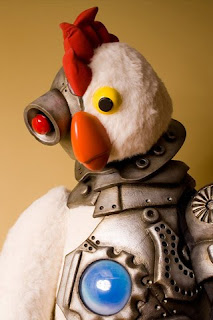
For anyone that's owned an original Optimus Prime toy or grew up with Saturday morning television in the 80s, Robot Chicken's host of characters will bring forth waves of nostalgia- and perhaps there is something innately amusing about seeing your favourite childhood toys swear and fight their way through sketch after sketch- perhaps. Now being broadcast in it's 4th series on American comedy network Adult Swim, UK fans are treated to the uncensored version of Robot Chicken's second series complete with a Christmas special, deleted scenes and customary audio commentaries. Still a relatively unknown show in the UK, it has garnered a cult following through it's forays into Star Wars parody and by virtue of the long list of celebrities (including Scarlett Johansson, Bruce Campbell, David Hasselhoff and George Lucas) who claim admiration and willingly participate in it's satirical reimaginings.


To the uninitiated, Robot Chicken represents the creation of Seth Green (Austin Powers, Family Guy, Buffy the Vampire Slayer) and Matthew Seinreich (editor of ToyFare, a monthly 'action figure' mag for collectors). 'Chicken' folklore tells it that the two met and 'bonded' over their mutual love of action figures, and therein a successful comedy format was born. Utilising an entire toy-cupboard full of action-figures and lovingly animated with old-school stop-motion, quick unfussy sketches are the modus here- the 20 shows on the DVDs here last a succinct 11 minutes each. The show pertains not to break new comedic ground or to offer anything resembling a deconstruction- it's merely a cipher for a generation drip-fed on pop culture. The humour on offer here is immediate, and Robot Chicken derives it's laughs from a cocktail of satire, slapstick and simple juxtaposition- with varying levels of success. The most relied-upon format here is also the least imaginative- take one well known figure from popular culture, for example Lindsay Lohan, and immerse them in a well-known scenario from another similarly well-known source, ie/ Highlander. The sketch writes itself as Lohan dumbs her way through the film's fantasy scenarios. The humour is obvious. Other sketches are more imaginative, but in a minority- a faux 1930s cinema-flick 'The Five Stages of Acceptance' (starring a giraffe stuck in quicksand) is genuinely clever, and offers a kind of slapstick comedy that could have been employed more widely across the series. Some of the gags fall completely flat, as the 'Fuck Rodgers' parody in which aliens mistake Buck's name, exemplifies. Moments like these are too frequent across the series, far too simplistic, and just not funny enough.

One gets the feeling that Robot Chicken's humour and success have, in some way, been predetermined. There is a whiff of 'insider-ism' to the whole project, as celebrities line up demanding voiceovers on the show. Having it send you up is perceived to be a kind of Hollywood badge of honour. Essentially a show by and for pop-culture geeks, Robot Chicken won't appeal to everyone- and even those who are attracted toward it's indulgent postmodern humour may find themselves wanting it to be 'better', something that will not discourage the makers, who set out it's mandate in the opening sequence: A chicken brought back from the dead by a mad scientist, is forced to watch a multiplex of TV screens, eyes held open, until insanity creeps in. It's a fitting metaphor for pop culture generally, and enforces the notion that noone involved with this show is taking it too seriously.

Robot Chicken Season 2 is released on DVD and Blu-Ray on September 28th via Revolver Entertainment

Review first published in Sound Screen
10 reasons why you should invest in Battlestar Galactica

First published on Virgin Media


It's sexy
Ok, so Starbuck is a girl (the 1970s version was played by the iconic Dirk Benedict) but she's still a bar-brawling, highly sexed, card-playing fighter pilot. The sexual tension between her and Admiral's son Lee 'Apollo' Adama results in some steamy scenes.

More plot twists than Lost and 24
Our home planet has been obliterated by nasty alien robots. But who is controlling them and where did they come from? Why are they attacking us? Do we even deserve to survive? BSG drops you in at the deep end and will keep you gripped the whole way through.

New = better
Although its based on the original series, the new BSG ditches the painted sets, body suits and toy spaceships in favour of mind blowing CGI. But don't worry if you were a fan of the original – you'll find the plenty of old-school references to keep you happy.

It's sci-fi Jim, but not as we know it
Forget the disappointment of the Star Wars prequels or the never-ending tedium of Star Trek, BSG will remind you why you fell in love with spaceship battles and laser-fights in the first place. Embrace that inner kid.

It'll make you fear your phone
Enjoying your new iPhone? Reading this on a laptop? Perhaps you have a thermostat. Could these things one day contribute to our extinction? You'll never look at the technology around you in the same way again...

Soap-opera emotion
BSG deals with the big issues in much the same way EastEnders does... so you can look forward to plenty of heartbreak, terminal illnesses, alcoholism, attempted murder and assisted suicide!

It's critically acclaimed
Critics have called it 'the most potent series on television'. Impressively, over the last five years it has picked up numerous awards, including four Emmys.

Religion never seemed so cool
Battlestar has more religious references than a Dan Brown novel, but the angels, prophecies and holy books are as gripping as any space dogfight.

It's brave
Tackling controversial issues like prisoner abuse and suicide bombings head on, BSG doesn't shy away from the ugliness of modern life. From elections to insurgencies, the parallels are clear but never preachy.

It will take over your life
With four seasons, a mini series, a feature-length TV movie and a prequel series planned for next year - you might find yourself having less of a social life once you've got your teeth into BSG. Not that that's a bad thing, but don't say we didn’t warn you...