Pages

Sunday, 31 January 2010

Belleruche - The Liberty EP: Review

North London's Belleruche have been busy since forming in 2005, self-releasing numerous 7 inches and touring the world over. Now signed to influential Brighton-based label Tru Thoughts, 'The Liberty EP' represents little more than a stop-gap between albums. Rather than making a 'novella' esq statement, Belleruche include a collection of remixes and acoustic reworkings to accompany the two original tracks that open the EP. As such, it's hard to pin down exactly what this record is about.


Openers "56% proof" and "Gold Rush" offer a soulful blend of guitar riff and minimal beats, while singer Kathrin deBoer croons lustfully in call and response in a manner which recalls both Lamb and Portishead's upbeat moments. The riffs overlap with ease and DJ Modest's beat-work is just that: modest, throughout. Never allowing excess, the music is constantly restrained . It's ample fodder for post-dinner party swaying- not enthralling enough to hold course being spun by DJs and not cerebral enough to entertain the home listener. It's crying out for just a little more 'punch' and would certainly benefit from being performed live. Elsewhere the acoustic reworkings are bluesy and competant enough, but the same critique applies. The five remixes which close the EP are varied in their reworkings- but there's a sense to which they've been bandied on to this EP, having nowhere else to live. All of this contributes to a rather thin whole. Belleruche are clearly talented and thoughtful, but would do well to make more assured, individual statements.

Ponyo: Review

It's an interesting crossroads for Hiyao Miyazaki. His films have charmed audiences worldwide and garnered critical acclaim- and in this case, earnt the distribution services of no less than Walt Disney. You could argue that Disney's been going through a kind of existential crisis post-Lion King, so jumping in bed with the world's "in vogue" animator is a by-numbers move. With previous films, notably Spirited Away and Princess Mononoke, Miyazaki has addressed a Japanese audience's history and tradition but with Ponyo, the themes are more universal.


We're introduced to Sosuke, an smart kid with a heart of gold. He lives with his (quite delectable- is it wrong to fancy cartoons?) mother, voiced by the infamous Tina Fey, in a town by the sea. Elsewhere, deep under the sea- a paranoid scientist is custodian to the oceans. His daughter, a magic-endowed fishgirl by the name of Ponyo, escapes in search of adventure only to be discovered and treasured by Sosuke. Therein follows a wonderful love story, full of innocence and charm. The film is visually beautiful, using a palette of simple watercolours. Similarly, the Western dub is spot on (and I didn't think I'd be saying that) with Liam Neeson providing real internal conflict as Fujimoto, and Cate Blanchett offering typically otherwordly tones as the Goddess of the sea.

This wouldn't be a Miyazaki film without the obligatory backdrop of mythology and 'end of the world' fable- however those expecting a subplot as profound as Princess Mononoke or Nausicaa: Valley of Winds may be disappointed: Ponyo is by design a light film, intended primarily for children. But even cast in this light, Ponyo offers a subtle politic, as ocean pollution and fishing-to-extinction are discussed in passing. A youthful audience may leave with a newfound appreciation for nature, without the film having been dogmatic or preachy. Ponyo is a beautifully simple kid's film, the kind anyone could appreciate- it's heart utterly in the right place.

Monday, 18 January 2010

Capitalism, A Love Story: Review

It's hard not to feel a little sorry for Michael Moore. Cue disquiet and confused stares. For all his earnestness, he's become the poster boy for an amorphous protest movement that is quick with relish but short on the detail. Moore finds himself a minor celebrity- a position which must sit uncomfortably with the supposedly egalitarian politics he espouses, but also of no surprise: Throughout his recent filmmaking, Moore has sought to put himself in the front line. These aren't one's 'conventional documentary'- where the filmmaker is but an invisible hand; Moore's films so consciously allow him a presence as to render his household name status something of a planned career aim. Perhaps that's cynical, but for better or worse his films have become common knowledge: even if one hasn't seen 'Bowling For Columbine', you'd be hard pressed to find someone who couldn't tell you which on side of the political fence Moore sits. This has arguably had it's benefits (publicising an oft-marginalised political discourse) but equally has not come without significant cost. Audiences will dismiss a Michael Moore film without a second thought due to the very notion of being so overtly preached at, coupled with the perceived factual inaccuracies of previous efforts. Moore's well-documented (no pun intended) selective myopia with regards to 'the facts' has even spurned a 'retort documentary', the cleverly titled 'Manufacturing Dissent' (Persistence of Vision Produtions, 2007)- a film which, ironically, was littered with as many errors as it accused Moore of.


With 'Capitalism: A Love Story', Moore is taking his broadest shot yet. Whereas previous films have aimed with specificity, 'Capitalism'- well, you can infer it's subject from the title. A brave move: Economics is hardly the world's most invigorating of conversation starters and yet 'Capitalism' is by some distancehis most affecting film of recent history. Previous endeavours have focused on dividing the audience along partisan lines but here, the inescapable truth is that the financial crisis hasn't discriminated. Recent events have so ordained that we're all affected (whether we know the difference between GDP and GNP or not). Irregardless of racial, ethnic, political or religious groupings, whether you supported Iraq or stood against it, if you believed in earnest that some gothy entertainer invoked Columbine- recent economics hasn't taken such trivialities into consideration. It's this very sense of far-reaching, bipartisan injustice that drives Moore's latest. For once, it's as if he's speaking for people rather than at them.

Opening with the philosophical preponderance: "What defines us?"- then seeking to demystify the myths of capitalism throughout both historical and contemporary example, it's a more basic approach than has been undertaken with earlier work but is no less polemical for it. We have the standard cocktail of investigative journalism, archive footage, interview material and stunt- Moore seeking throughout to play 'how things should be' against 'how they are'. There's the standard trope of letting a specific person act as telling of the whole (a journalistic practise made infamous by The Simpsons episode in which Bart gets his own news show entitled "Bart's People") - Moore continues to let his interviewees cry first before getting into the depth of the argument but regardless- the film's most successful moments should make you livid. We meet a former employee of Walmart, who left in acrimonious circumstance when his former employer cashed a secret life insurance cheque after the death of his co-worker wife, a sufferer of asthma. This shocking practice, referred to openly (if not affectionately) as 'dead peasant insurance policies' is apparently not uncommon these days.

Equally, the leaked memo from banking conglomerate Citigroup which states that the US can now be considered a 'plutonomy' (a society in which the majority of wealth is generated and consumed by the top 1%) displays an unsurprisingly elitist, and contentedly so, world-view. Moore uses these and other powerful examples to expose the fallacies in the free-market dogma that all shall benefit from competition, that such economic systems benefit society as a whole. But the most harrowing moments of the film come from his scrutiny of the $700 billion bailout orchestrated by perennial blame-figure Dubya, and former Treasury Secretary Henry Paulson. Through interviews with members of Congress and impassioned footage from the chamber itself, the entire act is presented as a financial coup d'etat, the biggest in history- an argument given credence when Moore asks the senator in charge of accounting for the bailout where she believes the money has gone. After some pause, she admits not knowing. A staggering moment for sure, but one only compounded when you read in the fine print that no accountability was demanded by Congress and review by a judiciary expressly prohibited. Furthermore, in drafting the legislation- Paulson (himself a former Goldman Sachs CEO) makes explicit his exemption from possibility of prosecution.


But while these moments may (perhaps should) evoke some small protest spirit within the audience, the film is equally riddled with flaws. In many regards, 'good documentary' (like a blog you return to) happens when the topics are specific. There is the realised fear in 'Capitalism: A Love Story" that Moore has bitten off more than he can chew- or more than could be dealt with reasonably in the film's already-overlong 127 minutes. The narrative is scattershot and flits between the bail-out, the wages of airline pilots, the marginalisation of unions, world economics, George Bush (he gives Obama the easiest of rides), 'good honest folk' being evicted, the ever widening disparity between rich and poor, advocating socialism and, of course (it wouldn't be a Michael Moore film without a trip to) Flint, Michigan.

Yet again, Moore strives to paint Flint as some microcosm for America's economic woes: he visits the former site of General Motors- articulating Flint's decline as endemic. Similarly, the moments where Moore takes centre stage prove the most trying, both in their placement and execution. After the exasperating details of the bailout are just settling in, the film cuts to a tongue-in-cheek action scene in which Moore is seen driving a security van to the banks, cornering them off with police 'crime scene' tape and, with a megaphone, somewhat impotently asking for 'our money back'. It's an unnecessary visual gag- the point of injustice having already been made. But Moore's earnestness, or ambition, necessitates that he indulges in the grandiose and entirely set-up faux-theatre performances. I would argue that there's a decent argument to be had about the legitimacy of sourcing protest movements as entertainment, or rather providing entertainment through protesting- but the overriding tone of this film is one that is deeply unfunny. Indeed, Moore forgoes the cartoons of previous films-and if there are jokes in this film, they're financial, and they're on us.

Early in the film, Moore narrates that when asked as a child, he stated that he wanted to grow up and get into the church, become a priest. Not for the fancy garb, he says, but for the community role they play. Conversely, a preacher is exactly what Michael Moore is. For even when the weight and substance of his arguments are irrefutable, Moore still allows room for theatrical showboating, for reminding the audience just who is making the case. Sadly, this- not the manipulative tone he takes in presenting said arguments (he never claimed to be objective), is his biggest and most valid criticism. Which is a shame, because by rights, this film should be a call to arms. We've been collectively duped, yet Moore can't just let the facts speak for themselves.

Capitalism: A Love Story is out Feb 26th via Overture Films

Monday, 21 December 2009

Review: Them Crooked Vultures, Sweethead - London Hammersmith Apollo, 18th December.

Oh, the rock supergroup. Throughout recent history, this coming together of celebrated musicians towards a singular endeavour has given ample opportunity both for expectations to be raised to dizzying, impossible heights and for that same lofty conjecture to be dashed with a dose of crushing realism. Troupes such as the cynically titled Audioslave come to mind, as does Dave Grohl's own ego-foray into collaborating with every metal vocalist of note, under the Probot umbrella. However for every Velvet Revolver there is a Travelling Wilbury's to inspire hope and provide counterweight. Whilst other genres enjoy collaboration freely (and I'm thinking here in particular of electronica's inbred remix culture and of hip-hop's willingness to cross-reference and intertextualise), for whatever reason (though I'd suspect ego plays no small part) rock and metal have embraced this concept with mixed results.


Tonight's gig, the second of two nights at London's Hammersmith Apollo theatre was arguably the hottest ticket in town last week. There is something in this unlikely trio which has captured the collective imagination. For most people, the very chance to witness Dave Grohl undertaking what many consider to be his true calling: playing, sorry, hitting the drums VERY HARD- would be reason enough to pay notice. And while stoner-rock master Josh Homme fronts the ensemble, it's afforded to the only Englishman on stage tonight to truly capture this partisan crowd's hearts. Yes, we're suckers for patronage when given the company of a bona fide British Rock Legend, and it's John Paul Jones' piano trills and smirking bass solos that receive the warmest applause throughout tonight's show.

Opening for the headliners was Sweethead- the outfit assembled by Troy Van Leeuwen (formerly of A Perfect Circle, now recording with Queens of the Stone Age). At a gig like this, it's hard to say to what extent the support band will even be acknowledged, let alone paid attention to. But the underlying tone of the evening is that it's a very cosy affair and having your friends' band to support you was a decent gesture on the part of Homme. But no token one. Sweethead offer a polished rock music, frequently dipping into moments of grungey distortion while never losing sight of melody. The band comprise a tight four-piece with Van Leeuwen grinding his axe to the left and marauding vocalist Serrina Sims stalking the stage. She's an enthralling spectacle, growling and hissing over doomy, thobbing riffs. By the end of their set, the sizeable audience has certainly been convinced.

And so, after the shortest of breaks- John Paul Jones walks onstage and collects his bass guitar from an clearly beaming roadie. Suffice to say, the immediate audience reaction to this sight was one of overwhelming, deafening approval. Grohl strolls out towards the kit, hands aloft, sticks high. Homme saunters casually towards the microphone and is joined by live member Alain Johannes. They don't launch into a track, there is no glitzy introduction. Them Crooked Vultures seem keen to dispell any preconceived notions of expectancy. "We're here to have a good time", extolls Homme, waiting for Grohl's count-in. Album opener "No One Loves Me & Neither Do I" is performed with a swagger, it's easy-blues giving way before long to a juggernaut riff that shakes the entire room. Homme sways as he croons, Jones bounces without ever breaking a sweat and Grohl, my god, is a sight to behold. Staring the audience down, teeth bared, arms and hair flailing- it's an entrancing sight, every beat pronounced with venom, every cascading roll performed with fire.

The first half-hour of their set was an utter joy- songs performed back to back, no respite offered. But, soon after this point- the concert begins to lose it's way, much in the same vein from which the album suffers. With specific regard to their songwriting, TCV have been accused of penning a fairly average record- and although it's certainly a great deal more convincing in a live context, the shortcomings of a limited set soon become evident. I'd personally argue that the album's flaws come from it's dependance toward Josh Homme's songwriting or vocal style. He's got a very particular sound and style, at once coy and bullish. His riffs and melodies are instantly recognisable, and while this is perhaps a decent trait to bear of yourself, a lot of Them Crooked Vultures set plays like Queens of the Stone Age b-sides; an outcome which you feel sells all involved a little short. The band play out the entire debut record and then indulge an 15 minute rendition of new song 'Warsaw' which I enjoyed immensely. Less a piece of articulate songwriting and more one of those jams you might have with all your bandmates at 2am, the track rolls and punches, builds and falls- the improvised nature of the parts bringing the band together onstage, their silent communication clearly evident in nods, smiles and interplay.

On many levels, the very existence of this band is a indulgence; the boyhood dream of playing with an idol, shared by Grohl and Homme. But regardless of justification or cause, the members seem to be enjoying themselves and a large proportion of the crowd leaves believing they've witnessed a special moment in history. Whether or not Them Crooked Vultures's music truly lives up to it's billing seems almost an irrelevance by the end of the show. Yes, half the songs are naff. Yes, Josh Homme has a tendency to overbear. But take it with the whimsy with which it's delivered: when they're good, they're very, very good.

Album of the Year: Charles Spearin - Happiness Project

It is perhaps a disservice to the merit of my chosen album that I should begin extolling it's virtues with a disclaimer, but there's something about 'end of year' lists that doesn't sit particularly easy with me. Subjective responses delivered with the assumption of authority- such declarations of conclusion can seemingly never please everyone, and accusations of bias, clique-ism, or narrow-mindedness usually follow such posts. Arguably, the format serves to inspire debate as much as to cement an album's place in the 'canon of whatever year'. So, it is with these concerns in mind that my choice for Album of 2009 doesn't aim to be the last word on the year's music, nor to allude to the objective 'best'. I've settled on a record which has not garnered mainstream press and is in itself the smallest of statements.


Having cut his teeth in some of Canada's finest (Do Make Say Think, Broken Social Scene, Valley of the Giants) Charles Spearin's solo debut album of sorts is a perfectly formed album of revelatory moments and life-affirming sentiment. Furthermore, you are unlikely to hear an album composed in this style ever again. It started as an experiment: to record audio interviews with the neighbours on his street regarding their perceptions of happiness. Having acheived this, Spearin listened to the recordings over and over- identifying interesting moments of cadence, turns of phrase, incidents where meaning of sentence and musicality of voice uplifted each other. Instrumentation was inspired directly from the inflections in voice that gave it 'a sing song quality'. And so came about eight pieces of music that wove interview and songcraft together with staggering success.

Spearin presses a small cross-section of society on the subject. Schoolchildren, the elderly, a women who has only recently had surgery to correct her deafness, a lady who works with the mentally ill- all give fascinating and articulate accounts, entirely subjective and borne of experience- that each provide small revelatory meditations on one of life's most involving philosophical questions. What is happiness? How does one attain or hold onto it?

The recording was pure chance, and must have been a deeply humbling and engaging process for Spearin and his neighbours. This record was the very antithesis of superstardom, it's composer merely facilitating the creative process. Furthermore, the album pertained to write itself or play out by serendipity. Spearin was a party to the album's compositional unfurling, and had no way of foreseeing how successful, if at all, the project would be. What struck me about this record more than any other released this year is that it sought, perhaps without knowing it, to rearticulate the creative process. What does it mean to be a recording artist in 2009? Whereas certain aspects of culture have only grown more gargantuan, allowing artists to speak to us from pedestals of spectacle and multi-media, the democratisation of recording technology has also allowed for an unprecedented return to music's more community-based roots, music as social glue, as 'event'. What's most lacking in our societies these days is community, and Spearin's album has reflected both the merits of brave experimentation and of talking to your neighbours.

Best track on album: Mrs Morris (reprise).

Opening and closing the record, Mrs Morris wonderful summation of love, happiness and gratitude is here set against dreamy guitars awash with reverb, an underlying beat and a playful Saxophone solo. Simplicity in itself and an utter joy.

Any improvements that could have been made:

Arguably, the album's most succesful moments are those in which the relationship between spoken word and musical turn of phrase are most evident. And certainly, the album is a real curio- released on a small independant and in no way seeking the mainstream approval. As with the artist's recording history- it will reward those who take time to discover it.

Best of the rest:

The XX:


A masterclass in simplicity and 'mood' - something far too many albums seem to have forgotten these days. And it's an excellent album, lyrically beautiful, addictive and unique.

Raekwon - Only Built for Cuban Linx II:


Proper 1995-sounding hip-hop like they don't make anymore. A truly refreshing reminder of class in a genre dominated by Floridas and Lil Waynes.

Lady Gaga - The Fame Monster


Having spent half the year criticising her out of hand, I had something of a Damascus moment. We're now agreed: Alluring, shameless, dirty, self-aware, ironic, disgusting, indulgent, a disgrace and reflection of part of society, art in it's truest sense and truly postmodern pop.

First published in the Sound Screen end of year review.

Monday, 23 November 2009

Débruit - Spatio Temporel EP: Review

The EP is a beautiful thing. Self-contained and precise, it allows for an artist to experiment more broadly than they would across a full-length and offers listeners a small morsel of reprieve in the midst of waiting between albums. Far too often the EP has been offered as little more than a single with a few sub-par b-sides thrown in. On Débruit's first release for UK label Civil Music, we are treated to the very definition of what an EP should be. With an album in preparation, 'Spatio Temporel' is a superb stop-gap: it's four tracks providing adequate taste of things to come and ample beat fodder for the discerning club-goer.


Opening with 'KO Debout' and perfectly setting the tone with an imprecise jangle, dreamily pitch-shifted vocals lull you into a false sense of security. A shimmering bassline moves to underpin the creative expression of samples above but to it's credit, the track never lurches into hedonism. 'Persian Funk' appropriates an eastern trill against octaved 8-bits; again the track is restless, but exercises restraint. Closer 'Nigeria What?' sees an African guitar-riff shirk around booming two-step, yet unlike Esau Mwamwaya and Radioclit's 2008 collaboration it refuses to descend into the carnivalesque. Production is astounding throughout as synths, decks, computers, guitars, glitch and live drums collide in a superbly clean mix. Débruit's music is instinctively curious, it's agenda truly cosmopolitan. One might raise slight concern that Xavier Thomas is globe-trotting- an act of aural tourism, as it were. But 'Spatio Temporel's influences, however obvious, are used so modestly that it's hard to find criticism. We await that full-length.

Tuesday, 27 October 2009

Happiness Project, Years, Do Make Say Think: Live Review

On the back of their 8th record 'Other Truths' (released this week), Toronto jazz-rock ensemble Do Make Say Think bring their accomplished craft to the Scala, one of London's most intimate 'larger' venues. Quite the anti-genre in itself, it could be argued that 'post-rock' has sadly become a parody of itself. There's a horde of bland instrumental guitar bands doing the rounds, each employing string sections and dystopic paranoia to spectacularly dull effect. Do Make Say Think have done well to avoid these trappings over their 15 year career: the band's recent output alluding to our shared warmth of character and community rather than preaching the apocalypse. Musically too, they've discovered and stuck to a sound which is both lifting and dramatic without veering into sinister or mournful overtones.

On any given occasion the band are a formidable proposition, but tonight their core six members are joined by a revolving cast of guests. All ten musicians appear across the evening, providing instrumentation and support for both the support bands here. Charles Spearin's Happiness Project and Ohad Benchitrit's Years; in essence, side-projects from the full time labour of the headliners. However, there's a genuine sense amongst the crowd that this isn't a typical 'headline + support' concert as such, but rather a collective of musicians who happen to perform under various guises, and are doing so tonight.


First, we're treated to The Happiness Project. Not your typical band in any sense, their melodies sourced not from conventional songwriting but from interpretations of recorded interviews with Spearin's neighbours loosely centred on the subject of happiness. Taking the cadence in these sampled voices as a basis, the band weave accompaniments, at times soft, at others more pressing, that synchronise wonderfully with the spoken words. Across the set's music and interview samples, we're given a broad understanding of what happiness is, from the profound (Vanessa, born deaf and after 30 years, undergoing groundbreaking surgery, gives a revelatory account of experiencing sound for the first time) to the seemingly trite (schoolgirl Vittoria, as she bemoans art lessons at school). Despite their early billing, the venue was already packed- some faces clearly knowing what to expect, but others undergoing a kind of conversion during the succinct 30 minute set. By it's end, happiness had seemingly been imbued on the crowd.

After a short break, Ohad Benchitrit appears on the stage and informs us that this is his debut performance. He's clearly a bit nervous as he begins the first of two long acoustic guitar pieces surrounded by the abandoned instruments of hisband-mates. But the jitters are quickly shed as his delicate and quite accomplished finger-picking style lulls the crowd into an attentive trance. Closing his set with accompaniment from the rest of the ensemble, Benchitrit leads with a rousing electric number, seemingly a never-ending crescendo. But it's a set of two halves, as the full-band material becomes gigantic and perhaps a tad indulgent compared with the stripped down austerity of his cyclical acoustic compositions.

After the briefest of interludes, Do Make Say Think emerge, taking up the entire stage, at launch into new-album-opener 'Do', a jovial epic which bounces along nicely on record, but is given a raucous energy in this setting. Elsewhere, the setlist conspires to remind just how strong their back catalogue is. Crowd favourite 'L'auberge de moutin noir' is augmented by performances of lesser tracks from early record 'Goodbye Enemy Airship'- a rawer record than any they've since recorded, and clearly an enjoyable moment for impossibly skinny guitarist Justin Small. Styled more appropriately for a 1980s punk rock band, Small, who cuts his teeth in garage-punk 2-piece Lullabye Arkestra, was the very figure of rock and roll on the night: headbanging through the crescendos of 'The Universe!' and using 'motherfuckers' as a term of endearment. Returning for an encore as the four-piece line-up that started the band, they indulge their own history with a performance of debut album track 'If I Only...'- a rare treat for an audience which enjoyed an evening of very rare treats.

First published in Sound Screen.

Sunday, 25 October 2009

ROFLMAO


01. Keep smiling it will be worth it in the end
02. Roflmao
03. Evening air
04. I like the water here
05. Dream of swimming

Debut EP: Recorded and mixed at Hawthorne Cottage, Falmouth.
First released March 2004 in a run of 50.

Monday, 19 October 2009

True Blood Season One: Review

With the second series having ended in America and us Brits playing catch-up, the Golden Globe and Emmy awarded first series of HBO's True Blood is released. Based on Charlaine Harris 'The Southern Vampire Mysteries' novel, True Blood details a present-day America where vampires and humans are, reasonably peacefully, co-existing. The introduction of a blood synthentic from which the show derives it's name means that these vampires- hitherto anonymous and hidden can 'come out of the coffin' and reclaim their place in society. It's an interesting premise for vampire fiction, alluding to the notion that a society is best judged by how it treats those on it's margins. Having legislated for change, the show allows for the obvious social tensions to play out.

Opening with one of most well-edited intro sequences you're likely to see, and set against the dreamy country-sleaze of Jace Everett's 'Bad Things'- the desaturated scenes of lustful depravity in the intro promise a hedonistic cocktail of temptation and dark sexual desires. This is a stylistic trope, a 'dirtiness' that the show would have done well to employ throughout but instead, it's impeccably lit and polished.


Set in deep-south town Bon Temps, True Blood focuses on telepathic barmaid Sookie Stackhouse (Anna Paquin- X-Men: Last Stand, Joan of Arc). Plagued by the constant interruptions of voices in her head, Sookie comes across as a naive but 'good of heart' protagonist. Her life is turned on it's head by the arrival of Bill Compton (Stephen Moyer- 88 Minutes, Empathy) a vampire who has taken up residence nearby. Finding solace that she can't hear his thoughts, Sookie and Bill begin a relationship which is characterised by transgressions and the voices of disapproval from all sides. Sookie in particular is cast excellently- Anna Paquin finding a convincing balance of timidity and strength. Elsewhere, character is evoked to worryingly bad effect.

True Blood employs a large cast and attempts sub-plots in an attempt to construct Bon Temps as a multifaceted and engrossing town. While Bill and Sookie fall in twists and turns, a who-dunnit moves the plot along in the vein of Twin Peaks. So-called 'fang-bangers' (women who sleep with vampires) have been offed by a vigilante: a narrative reminiscent of the racial tensions and prejudices familiar to the history of the region. Throughout the series, the viewer is invited to speculate on possible culprits. But whereas Twin Peaks masterfully posited all it's characters on a level-playing field, like a soap-opera, and genuinely shocked upon it's reveal, True Blood's murder mystery often feels like it's merely going through the motions, without enough ambiguity. In ascribing possible motives without discretion, depth of character is dropped and True Blood forgets to embellish these roles.

Elsewhere, peripheral characters are afforded an equally two-dimensional persona. Sookie's grandmother seems able only to utter long-viewed moralities and wisened summations. One may recognise Detective Bellefleur (Chris Bauer) from The Wire, but whereas Frank Sobotka's character allowed for a virtuoso performance in conflict and internal tension, Bauer's role here merely takes cues from others. Sookie's brother Jason becomes involved in a drug-addled relationship- interesting to note that here, vampire blood is both an aphrodisiac and hallucinogen- but kaleidoscopes of colour and bad CGI are a little embarrassing. The vampires on offer are pop-culture fiends, clad in leathers and capable only of mouthing annoyingly hip vampiric threats, deriving pleasure from their nature, clubbing at vamp-hot spot Fangtasia, posing endlessly.

The most problematic characters are brother and sister Lafayette Reynolds (Nelson Ellis - The Soloist) and Tara Thornton (Rutina Wesley- Numb3rs). True Blood gives these roles huge importance in first series and sets them up with much promise, only to fall back on stereotypes which border on the offensive. In a town populated by hicks, the quick-thinking and witty Lafeyette is presented as the show's most entertaining and subversive character. But as the series develops, his falls back on cliche and convention. Introduced as a chef, he's then a roadie, a drug dealer, and finally- a gay male prostitute. Witticisms are replaced by tired dialogue that almost pertains to write itself- much in the same way Samuel L Jackson is guaranteed to say 'motherfucker' in any given film. The plot involving his sister is of equally bad taste. Tara seeks the approval of her mother, a violent alcoholic who believes that she's possessed by a demon. Mother then undergoes a voodoo exorcism, leading to a patronisingly simplistic mother-daughter reconciliation. The deployment of black stereotypes here, both in Lafeyette's character and in Tara's storyline, seem designed to evoke a kind of unrefined 'Southern Truth'- but are unbelievable as plots and unpalatable as entertainment.


Despite a limited imagination, True Blood has garnered a following both here and in America (where it's been commissioned for a third series) based on it's juxtaposition of vampirism and risque sexuality. Creator Alan Ball has openly admitted that he paid little attention to recent vampire fiction before working on True Blood, and it shows. Comfortable with relying on the progress made by others, True Blood is an entertaining but unremarkable series offering conventional vampires and stereotypes where characters should be.

First published in Sound Screen

Saturday, 10 October 2009

Langue

I am bound to this art
like a sprouting plant
from a muddy red flowerpot
perched delicately,
overlooking.

Tendered and treated,
Such ordered clutter.


Friday, 9 October 2009

Lethal Bizzle - Go Hard: Review

Riding a wave of indie acceptance comes the third album from Walthamstow's Lethal Bizzle. Since his last record dropped, Bizzle has enjoyed a high ranking on the NME cool list and acquired a host of mainstream rock buddies, some of whom contribute here. One may forgive him for feeling like he's at the top of his game, but on this evidence, all the swagger is misplaced.


The problem with this album is that it's derivative, both musically and lyrically. From start to finish 'Go Hard' sounds content merely to go where others have led. The opening salvo of 'Money Power Respect Fame' and lead-single/title track 'Go Hard' are anthems to the kind of mafioso gangsta lifestyle usually associated with American hip-hop. The messages, however authentic or not, are all-too familiar. When later in the record, Biz claims that "living in London is like living in the Middle East", there's not the sense that anyone, least of all Bizzle, really believes it. Conventions of the genre, maybe- ego and swagger. But when he famously called out David Cameron out last year for making similar remarks without the authenticity of lived experience to back it up, Bizzle took upon himself a certain responsibility.

Musically too, it's a slow start to a record which by it's very name should be entitled to open with a bang. Beats are initially tempered and sonically thin throughout, as is much of the production. A study published recently found that teenagers prefer the sound quality of their mp3 players to vinyl, and 'Go Hard' sounds very much like it was produced with this demographic in mind. 'Crazy Nightmare' was recorded with Fruity Loops, the retro beats software. The vocal mixing isn't much better either, sloppy multitracking of takes giving some verses a lack of clarity. Elsewhere, 'Push it' appropriates Salt'n Pepa's standard for what must be it's millionth reuse, slamming it against a sub-Calvin Harris chorus. The electro-octaving of 'Going out tonight' provides ample foil for Lethal B to tell us that he's, yes, going out tonight. It's a euphoric message for a partisan crowd of ravers, or it's meant to be. Rockstar, a Gallows-powered literal foray into the attractive hedonism of guitar rock merely evokes painful memories of the nu-metal era.

Perhaps this is all a reflection of where Lethal Bizzle is at. Clearly aiming to for the 'crossover' market, the album calls in favours from celebrity superproducer de jour Mark Ronson on 'Lost my mind'. Thankfully, there isn't a horn section anywhere to be heard on the track. Ronson instead evokes the kind of harmonica riff reminiscent of so much American hip-hop history. It's one of 'Go Hard's strong points, and is quite telling of the record itself. A sprawling array of derivative music and forgettable lyrics, it's the sound of an artist who has looked back on his MOBO awards, Never Mind the Buzzcocks guest appearances, controversy-baiting newspaper headlines and thought he could rest on his laurels, let the music 'happen' and watch the money roll in.

First published in Sound Screen.

Wednesday, 7 October 2009

Thirst: Review

The vampire is enjoying something of a renaissance of late. One was beginning to feel sorry for this once terrifying figure of the night, made safe and rendered harmless through parody and misrepresentation. Where once aristocratic counts stalked the night in search of virgin blood, now our vampires come in jeans, smoking cigarettes and wearing shades. They’re borderline camp.

But having endured such indignities, it would seem that Nosferatu is rediscovering his bite. Thirst is the latest in a welcome spate of reimaginings that update the vampire concept with contemporary social evils. A new generation of vampire fictions has emerged, with film of the year contender Let the Right One In doing much to dispel the notion of vampirism as something cool, attractive or anything but a deeply horrible, lonely experience. Thirst is very much in this tradition, exploring not outward expressions of violence but internal conflicts.


As such, it is a film of some considerable modesty. Director Park Chan-wook (Old Boy, Sympathy for Lady Vengeance, I’m A Cyborg But That’s OK) has crafted a complex exploration of the self, using the vampire as a foil with which to question certain moralities. The film is loosely based on Emile Zola’s novel Therese Raquin, and our protagonist here is Sang Hyun, played by Song Kang-ho (Sympathy for Lady Vengeance, The Host) – a revered priest and a man of immaculate moral standing who becomes infected while doing the Lord’s work (volunteering in medical trials). Who better to corrupt than a man of God?

Thirst enjoys the ambiguity of its opening half hour. Vampires are never mentioned by name, and when it is finally out in the open, the priest’s conversion has already occurred. It’s a retrospective diagnosis that allows the audience to connect emotionally with him before he can be labelled. As the only one in 500 to survive the medical trials, Sang Hyun develops a reputation for miracles and his church is mobbed by encamped devotees.

But he falls from grace into sin, allowing for a discussion of religiosity that doesn’t employ the traditional iconography: there are no references to holy water, fear of the cross, or other conventions of the genre popular in Western films. Korean horror has long operated along more imaginative, psychological arcs. Dismissing certain aspects of vampire mythology allows for a successful reconstruction of what makes this figure so terrifying and yet alluring.

As Sang Hyun retreats into nihilism and an affair with unappreciated housewife Tae Ju (Kim Ok-vin of Desapo Naughty Girls fame and the very image of temptation) his choices are understandable and his internal conflicts unquestionably real. The casting of Kim Ok-Vin is excellent, subverting the image of an actress who made her name winning a beauty pagaent. Chan-wook gives her a feisty role, which she performs with a maturity that never allows her character merely to play second fiddle to the protagonist’s descent into lust and depravity. Both characters undergo transformations of sorts and both speak convincingly of the human condition. Plot and character are evoked intricately, and the film mirrors this level of detail in its composition. An initial palette of pastels gives way, as the plot unfurls, to stark contrasts and bright colours in a move which mirrors the protagonist’s darkening existence.

Despite the odd nod to the gothic, and a generous smattering of crimson towards the film’s end, Thirst is hardly a horror film at all. Conventional scares are few and far between, but raising the hairs on the back of your neck was never this film’s intention: the overriding tone is light and it’s frequently funny.

Thirst is a typically accomplished film from a director and production team from whom we should expect nothing less. Going a long way towards undoing the damage wrought by the pop culture vamps that America so readily churns out, Thirst is an intelligent and imaginative addition to the canon of vampire films that refuses to descend into parody.


First published in Sound Screen.

Tuesday, 29 September 2009

Robot Chicken Season 2 DVD: Review

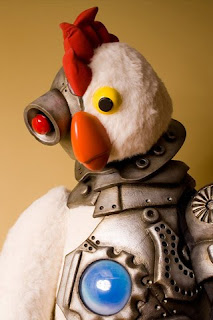
For anyone that's owned an original Optimus Prime toy or grew up with Saturday morning television in the 80s, Robot Chicken's host of characters will bring forth waves of nostalgia- and perhaps there is something innately amusing about seeing your favourite childhood toys swear and fight their way through sketch after sketch- perhaps. Now being broadcast in it's 4th series on American comedy network Adult Swim, UK fans are treated to the uncensored version of Robot Chicken's second series complete with a Christmas special, deleted scenes and customary audio commentaries. Still a relatively unknown show in the UK, it has garnered a cult following through it's forays into Star Wars parody and by virtue of the long list of celebrities (including Scarlett Johansson, Bruce Campbell, David Hasselhoff and George Lucas) who claim admiration and willingly participate in it's satirical reimaginings.


To the uninitiated, Robot Chicken represents the creation of Seth Green (Austin Powers, Family Guy, Buffy the Vampire Slayer) and Matthew Seinreich (editor of ToyFare, a monthly 'action figure' mag for collectors). 'Chicken' folklore tells it that the two met and 'bonded' over their mutual love of action figures, and therein a successful comedy format was born. Utilising an entire toy-cupboard full of action-figures and lovingly animated with old-school stop-motion, quick unfussy sketches are the modus here- the 20 shows on the DVDs here last a succinct 11 minutes each. The show pertains not to break new comedic ground or to offer anything resembling a deconstruction- it's merely a cipher for a generation drip-fed on pop culture. The humour on offer here is immediate, and Robot Chicken derives it's laughs from a cocktail of satire, slapstick and simple juxtaposition- with varying levels of success. The most relied-upon format here is also the least imaginative- take one well known figure from popular culture, for example Lindsay Lohan, and immerse them in a well-known scenario from another similarly well-known source, ie/ Highlander. The sketch writes itself as Lohan dumbs her way through the film's fantasy scenarios. The humour is obvious. Other sketches are more imaginative, but in a minority- a faux 1930s cinema-flick 'The Five Stages of Acceptance' (starring a giraffe stuck in quicksand) is genuinely clever, and offers a kind of slapstick comedy that could have been employed more widely across the series. Some of the gags fall completely flat, as the 'Fuck Rodgers' parody in which aliens mistake Buck's name, exemplifies. Moments like these are too frequent across the series, far too simplistic, and just not funny enough.

One gets the feeling that Robot Chicken's humour and success have, in some way, been predetermined. There is a whiff of 'insider-ism' to the whole project, as celebrities line up demanding voiceovers on the show. Having it send you up is perceived to be a kind of Hollywood badge of honour. Essentially a show by and for pop-culture geeks, Robot Chicken won't appeal to everyone- and even those who are attracted toward it's indulgent postmodern humour may find themselves wanting it to be 'better', something that will not discourage the makers, who set out it's mandate in the opening sequence: A chicken brought back from the dead by a mad scientist, is forced to watch a multiplex of TV screens, eyes held open, until insanity creeps in. It's a fitting metaphor for pop culture generally, and enforces the notion that noone involved with this show is taking it too seriously.

Robot Chicken Season 2 is released on DVD and Blu-Ray on September 28th via Revolver Entertainment

Review first published in Sound Screen

10 reasons why you should invest in Battlestar Galactica

First published on Virgin Media


It's sexy
Ok, so Starbuck is a girl (the 1970s version was played by the iconic Dirk Benedict) but she's still a bar-brawling, highly sexed, card-playing fighter pilot. The sexual tension between her and Admiral's son Lee 'Apollo' Adama results in some steamy scenes.

More plot twists than Lost and 24
Our home planet has been obliterated by nasty alien robots. But who is controlling them and where did they come from? Why are they attacking us? Do we even deserve to survive? BSG drops you in at the deep end and will keep you gripped the whole way through.

New = better
Although its based on the original series, the new BSG ditches the painted sets, body suits and toy spaceships in favour of mind blowing CGI. But don't worry if you were a fan of the original – you'll find the plenty of old-school references to keep you happy.

It's sci-fi Jim, but not as we know it
Forget the disappointment of the Star Wars prequels or the never-ending tedium of Star Trek, BSG will remind you why you fell in love with spaceship battles and laser-fights in the first place. Embrace that inner kid.

It'll make you fear your phone
Enjoying your new iPhone? Reading this on a laptop? Perhaps you have a thermostat. Could these things one day contribute to our extinction? You'll never look at the technology around you in the same way again...

Soap-opera emotion
BSG deals with the big issues in much the same way EastEnders does... so you can look forward to plenty of heartbreak, terminal illnesses, alcoholism, attempted murder and assisted suicide!

It's critically acclaimed
Critics have called it 'the most potent series on television'. Impressively, over the last five years it has picked up numerous awards, including four Emmys.

Religion never seemed so cool
Battlestar has more religious references than a Dan Brown novel, but the angels, prophecies and holy books are as gripping as any space dogfight.

It's brave
Tackling controversial issues like prisoner abuse and suicide bombings head on, BSG doesn't shy away from the ugliness of modern life. From elections to insurgencies, the parallels are clear but never preachy.

It will take over your life
With four seasons, a mini series, a feature-length TV movie and a prequel series planned for next year - you might find yourself having less of a social life once you've got your teeth into BSG. Not that that's a bad thing, but don't say we didn’t warn you...

Wednesday, 16 September 2009

The Foreign Beggars - United Colours of Beggattron: Review


Ignore if you will the slightly cheesy album title and badly-drawn cover art, there's much more to this album than the tongue-in-cheek concept they suggest. Since 'The Foreign Beggars' debuted in 2003, this crew have been busy- building a collective, collaborating with Bjork and Gorillaz, presenting a regular slot on the BBC Asian network and gigging relentlessly. Point is, they might have been too rushed in that rap game to spend much time on the cover art. Spin 'United Colours of Beggattron', the Beggars' 4th album proper, and it practically sizzles from out your speakers. Eschewing old school 'sample-based' hip-hop in favour of beat programming, glitch and cosmic synths, the production here has more in common with the avant stylings of New York's Anti-Pop Consortium than the more mainstream pop of East London's Dizzee Rascal. Regardless, all the rap here is infused with that irresistable London swagger. For the most part, lyrics are insightful and imaginative- a tight cocktail of bravado, wordplay and storytelling. The MCs and guests here compliment each other well, both in terms of tonality and persona. There's a broad array of music on offer here too, from the soulful 'Move Higher' to the club-ready of 'Keeping the line fat', a track boasting a fantastic synth line straight of a Boards of Canada record. We get taken on a tour of the scene- from dancehall to grime, funk to electro. It's very nearly a start-to-finish LP, but for a few trying moments. The faux-hospital radio skit is insufferable: it's protagonist's Indian accent a cringeworthingly poor decision. Elsewhere the odd line falls flat, the occasional rhyme doesn't quite- but I'm splitting hairs. The masterful 'Seven Figure Swagger' is the sound of a crew at the top of it's game, making beats and rhyme for fun. There's no harm in aiming high, but nobody gets there without working for it. A decree that seems to have rubbed off on The Foreign Beggars.

First published in Notion Magazine, London, October 2009

Thursday, 3 September 2009

District 9: Review

The much anticipated debut feature from Neill Blomkamp, District 9, goes some distance to justifying the quiet hype it has generated. A sci-fi flick that promises to endear itself beyond the genre's partisan crowd, the buzz around it has been cleverly built up through virals, 'human only' signage in city centres and notably, a Peter Jackson endorsement. The movie itself is frequently entertaining and interesting - but is more conventional than it pretends and not as clever as it should be.


District 9 opens with faux-archive footage of an Alien mothership landing over Johannesburg. Rather than nefarious invaders, it's full of refugees who are doled out squalid shanty-town existences and segregated by the South African government- the allusions to apartheid are immediately obvious, but never overstated. There's xenophobic hostility but the aliens- referred to as 'prawns' are generally regarded with pity, despite hints of an formerly advanced civilisation. It's an interesting reversal of the standard UFO axiom- here, aliens have more to fear from us than vice versa. Historical particulars are glossed over- the plot is evoked initially through eye-witness interviews and scatterbrain archive footage- colluding to build a sense of place, rather than of story. As such, District 9's opening 10 minutes are utterly compelling, it's alternate present day rich and involving.

The film eventually focuses on anti-hero Wikus van der Merwe, an awkward security official charged with evicting the residents of District 9 and moving them to concentration camp District 10. Wikus' nervousness contributes to an encounter with an alien liquid, and he undergoes a genetic transformation in scenes reminiscent of The Fly. His own government turns on him, carrying out specious military experiments. Evading his captors with a running commentary of humourous expletives, an unlikely alliance is formed with an alien freedom fighter. This pairing up is conveyed well, but as this story emerges the more interesting narrative structures fall by the wayside in lieu of standard 'action-blockbuster' storytelling. Indeed, with only a single narrative arc, the second half of the film felt very much like a computer game. Go to a location, shoot things, acheive mission targets, next level. Tiring gunfights replace plot dynamic, and the many shots of soldiers blown apart with 'cool' alien weaponry quickly lose their novelty.

District 9 succeeds in establishing a fascinating hyper-reality- which is then compromised by it's linear story. Blomkamp's earlier short film 'Alive in Joberg' (upon which this is based) maintained a tense ambiguity, but District 9 becomes disappointingly conventional and confused about what it's trying to be. Visually, it's a treat- CG is used intelligently, well shot if not entirely 'cinematic' and edited with tightness. Anyone feeling alienated by the genre (groan) won't be convinced, but District 9 is an interesting if not profound addition to the sci-fi canon, full of charm, intrigue and promise.

First published in Planet Notion

Tuesday, 18 August 2009

The Yes Men Fix the World: Review

'The Yes Men Fix The World' is the sequel to 2003's 'The Yes Men': documentaries following two anti-corporate activists (Andy Bichlbaum and Mike Bonanno) as they stage a variety of stunts aimed at highlighting global injustice. Their primary weapon in this war is subterfuge- the filmmakers gain the trust of industry and media whilst masquerading as representatives from government or big business. It's a format we've grown accustomed to through the comic-doco style of Michael Moore and the pantomime spoofing of Sacha Baron Cohen's characters. But there's a precarious line between investigative journalism and getting your comedic kicks...


In the first section, the target is Dow Chemical and Union Carbide's refusal to accept responsibility for the Bhopal industrial disaster of 1984 - a tragedy estimated to have killed 25,000. This culminates in a BBC interview with a "Dow representative" promising 12 billion dollars of compensation to those affected. Audacious, yes- but there's little attention paid on the human tragedies of the story. It's used as a tool to rail more generally against the ambiguous 'greed' of 'big corporations'. When the two filmmakers do visit India, it's only to validate their position.

It's a self-congratulatory theme which informs the limp protests against ExxonMobil and Halliburton (soft targets for the protest movement) which are to follow. The film's most succesful argument comes later, and is also it's simplest: Thousands of New Orleans residents have been evicted from their homes in the wake of Katrina. The filmmakers reserve judgement here, letting the subjects speak for themselves- and it makes for convincing footage. But elsewhere, wistful acoustic guitars for background music and stoner-humour do little to validate their arguments, merely establishing that this is a film very much preaching to a partisan audience.

The Yes Men establish their raison d'etre as defenders of justice and the oppressed, patting each other on the back at regular intervals along the way. Whilst their stunts are impressive and their hearts in the right places, the film suffers from nonchalance toward it's subjects and arrogance in it's arguments. It's a tone which is self-defeating and wholly unneccesary when compared with peers of the genre. 'The Czech Dream' (2004) remains humble, whilst longtime comic/activist Mark Thomas is an expert in letting the facts hold centre stage. Occassionally funny but too frequently lightweight, 'The Yes Men Fix the World' raises serious questions, not about fostering social change through comedy, but about the legitimacy of using protest movements as a source of humour and entertainment.

First published in Planet Notion.

Monday, 17 August 2009

DJ Yoda: How to Cut and Paste (30s Edition) : Review

The '30's edition' is the latest in DJ Yoda's 'How to cut and paste' series; a now-established blueprint from which we've received an 80s mash-up, a country western themed disc and a foray into movie soundtracks. On this mix, Yoda samples a range of 1930s music and 'updates' with an array of beats and scratches.


The cult of the mash-up has enjoyed popularity of late due to the rise in availability of easy to use software. But the basic concept of 'the remix' has it's roots in something far older than Ableton. Historically, folk music relied upon certain pieces which were passed down and reinterpreted. A DJ's role is no different. Scouring an archive, reinterpreting. It's a similarly communal experience, rewardng those who pay attention. Faces on the dancefloor light up as they recognise a sample. From a DJ's perspective, such reappropriation can be a safe bet. And here's where it gets problematic.

The '30s edition' is, no doubt, enjoyable. Who wouldn't care to listen to Cab Calloway croon over 'Minnie the Moocher' or reminiscise for the 'Big Rock Candy Mountain'? And if Louis Armstrong's ode to 'Cheesecake' doesn't elicit a smile on first listen, you're incapable of human joy. The problem with this mix is not the source material, it's in the lack of imagination applied to it. DJ Shadow and Cut Chemist applied a limited scope and acheived maximum results with their 'Product Placement' tour- through juxtaposition of samples. Yoda, however, seems content merely to apply morose beats and spoken word samples. It's a surprisingly lazy effort that would make Kool Herc shudder. Like all you have to do is spin an LP and drop a drum-loop on it.

I kept hoping for something engaging: a Robert Johnson riff against a Raekwon a-capell. Thelonius Monk vs Biggie. Instead, almost-verbatim reperformances. Maybe this mix wasn't intended for these discerning ears- perhaps it's meant for people who can only listen to vintage music once it's been co-opted into a known style. Something that goes against the very premise of being a DJ. If Yoda can craft a career from putting beats on records, fair play. But if kids can't listen to the originals on their own merit, then I despair.

First published in Planet Notion.

Thursday, 6 August 2009

Cabaret Whore: Review

‘What is cabaret without pain?’ implored the knife-wielding French diva 'La Poule Plombee', one of three characters portrayed in Sarah-Louise Young’s 'Cabaret Whore'. A fitting closing statement for a performance which parodied the conventions of the genre with style, if not substance. A cocktail of anecdotal storytelling, music and dance which at times borders on the burlesque, cabaret is enjoying something of a rennaissance in comedy circles. Before travelling to the Edinburgh Free Fringe, the Camden Head was treated to a preview performance.


A foul-mouthed redneck porn star, a snooty librarian who idolises Jordan and an embittered Piaf-a-like paraded their loneliness, regrets and traumas through jovial song, before collapsing in tears under the weight of their pains. Young has a powerful voice capable of carrying her character's idiosyncracies; but whilst you couldn't fault the ability or indeed the effort, there was a feeling that 'the show' sometimes overshadowed the humour. Attempts at audience participation were met with uncomfortable silence. Social observation wasn't as clever as it thought. Though pain was the central premise of Young's charicatures, it was far from a painful experience. More an amusing spectacle that promised much but failed to deliver where it really mattered.

First published in Camden Fringe Voyeur

Wednesday, 5 August 2009

Benson: The People's Fish

Anglers are today mourning the death of what is believed to be Britain's biggest carp. Commonly referred to as 'the People's Fish', Benson was introduced into the lakes in 1995, and at the time of his death weighed 64lb. The BBC reported that he had been caught up to 70 times during "his 13 year career". Career?

Anyway. Tony Bridgefoot, owner of Bluebell Lakes on the Cambridgeshire/Northamptonshire border, thought the fact that prospective fishers did not have to join an expensive fishing syndicate but could fish on a day ticket meant the carp was accessible to everyone.

"They sort of adopted it and took it to their hearts, and if you were lucky enough to catch the fish or even see the fish it was perfectly clear what a beautiful creature it was."

Here follows Benson's Best Bits.

Friday, 31 July 2009

Broken Embraces: Review

Thank the heavens for Broken Embraces. In a summer that has been dominated by dismal Hollywood refranchising (Terminator, Wolverine, Transformers) and arthouse shock tatics and self-indulgence (Antichrist, Synecdoche New York), Pedro Almodovar's 17th film is a breath of fresh air. The trailer's wordless sequences give nothing away and to those not familiar with the director, I doubt it will invite your interest. But dare to be curious and you will be pleasantly surprised. This is a serious piece of filmmaking; it will reward both the cinephile and the casual viewer.


Penelope Cruz is the ostensible 'star' of the film, though the film is reticent to focus on a particular protagonist or narrative. The plot is embellished as the film jumps between 1994 and 2008: a complex web of storytelling that only reveals the particulars at the film's climax. We meet a blind cinematographer who lives under a pseudonym, an aspiring documentary filmmaker seeking to ruin his father's memory, a jealous financier and of course, Penelope Cruz herself- in the role of Magdelena: a typically passionate, but dissatisfied woman upon whom entire film turns. The film refuses to conform to type; allowing for a myriad of complex, often contradictory emotions.

A touch of self-referentialism never hurt anyone, and Broken Embraces boasts a 'film within a film' storyline that ties all the disparate elements together. Whereas other films have attempted this ad naseum (Synecdoche- to it's absolute limit), it never feels laboured or indulgent. Broken Embrace's characters carry heavy burdens- but the light hearted 60s romp 'Girls with suitcases' within the film is used as much to distract as embolden. It's subjects are dark, but the film's tone is brisk.

This is not a typical indie flick. It lacks the pace of genre-staples such as 'Y Tu Mama Tambien' or 'City of God'. But throughout the film are clues: A delicate scene with a television playing an Ingrid Bergmann film in the background. Casting agents instructing Magdelena to wear her hair 'like Hepburn'.This is classic cinematic storytelling, beautifully shot and acted, rooted in the style of 50s Hollywood.

First published in Planet Notion

Compositional aesthetics in children's literature.

I enjoyed a conversation recently with an as-yet unpublished author of children's stories. Another of my friends is devoted to this craft, though I am no expert on the particulars, the histories and conventions of the genre, nor the difficulties in embellishing it with that dislocated sense of fantasy and reality concurrent. However, certain aspects of the genre draw my interest, and certain aspects in the production can be seen to mirror those of more adult literature. I remain convinced that the subtelties of storytelling are as nuanced no matter your target audience, no matter the particulars of your narrative style or form- all writing is fiction at it's root, all writing strives to entertain, prove and disprove.

We are all condemned to silence unless we create our own relation with the world and try to tie other people into the meaning we thus create. That is what composing is.

Children's stories are embedded in the rich tradition of folklore and fable. The simplistic language used in both mediums is employed to appeal to the widest possible audience. There is an allegorical quality to this storytelling which demands itself to be heard. It's raison d'etre is to interpellate, and so broaching a mass market is entirely in agreement with this. If one is able to reduce any series of words and sentences to it's discursive core, then perhaps one could argue that children's literature is a tool of socialisation much in the way that fables contain moralistic and ethical codes that we are meant to learn from. I was curious though as to the extent an author conciously writes these allegories and subtexts into their character, the extent to which these characters are 'allowed to breath'.

I believe that this is an authorial difficulty which is not exclusive to children's literature. All writers seek to prove something. Perhaps the form of the fable allows for a greater indulgence in political subtext which can come across merely as clumsy storytelling in more contemporary forms. Is it possible to suspend an adult audience's critical disbelief with success throughout an extended fable storytelling format? My mind recalled, in particular, Lars Von Trier's 2003 film Dogville, which structurally is set out in chapter format, is narrated by an omniscient and disembodied male. I think Von Trier is a pretty appropriate example of perhaps the shortcomings of fable format in adult fiction. His biggest shortcoming, throughout his back catalogue of uber-realist and more recently, more artifice laden filmmaking, has been that he forever regards his characters merely as plot devices, political tools to manipulate in order to prove his artistic point. His films are thinly veiled thesis, and he expects an audience to be moved to agreement, or shocked into a reactionary disagreement. Arguably, through allowing his characters no room for human development, he is shutting the door on any significant emotional attachments being drawn between the audience and text. The intended socialisation of his films is more easily dismissed, thanks largely to the arrogance with which he composes his thesis/story and expects you to be passively subjected to it's self-evidence.

The socialisation which occurs in children's literature is, though composed in a blunter fashion (through the language of fable, as discussed), is of a more progressive nature. There are certain edicts, certain established codes of behaviour which are transmitted and naturalised to the child, and it could be argued that these are of unspeakably important value to society, and in the development of that child's character.

I was curious as to how these concerns about characterisation manifested in composition, in the extent to which an author of children's literature knowingly embeds these cultural, moral, ethical codes and resolutions into their characters and narratives. Are characters composed firstly for their political subtexts, or does a story reveal itself (shudder) "naturally" ? Conversation moved on to discussion of Jung's archetypes, and other historically noteworthy examples of a collected embodiment of a particular representation.

Moreover, if the purpose of fable is to interpellate cultural codes, conventions, valuable information otherwise intangible- is then it limited to imparting what has already been quietly agreed upon? Should representations of, say, good and evil, valour and cowardice, integrity and untrustworthiness, neccesarily be conventional? How far can an author attempt to transgress whilst maintaining the culturally-affirmative element of the genre- a stylistic trope which cannot be disregarded for therein lies the convincing aspect of the narrative.

Wonderful conversation- a fragment that I did not want to lose.

Tuesday, 21 July 2009

The Market

The market had been there since anyone could remember. For six days a week, the streets were empty and sullen, the shop facias faded in reverence to the sun; all things remaining closed in anticipation. The rusted skeletons of stalls formerly and stalls-to-be were carted with infrequency in the early mornings of the week and put in place: helpful council red paint used cleverly to demarcate each allocation. In doing so, it etched a permenance onto the concrete of the streets, it earmarked the market's timeless validity.

Once a week this dormant calvacade would awaken into splendid colour and vibrancy; from my second floor windows I could see these empty streets and eventual hubub in something like time-lapse. Curiosity would get the better of me, and anyway- are we not composed within our environments? Oh, colour me in.

On market day, it was as if the entire neighbourhood could not contain it's excitement. Shopkeepers would arrive on six thirty, coming in white vans, the families in 4x4's to lay out tables and build up their palaces: neat arrangements of goods, wares and vividly coloured price tags. By ten o' clock that morning the streets would be filled with a mingling fraternity, many colours of skin, eager to be impressed.


On this particular Sunday, such recently uninspired weather had produced a thick July glow. Stalls were laid out like tents inviting all the hustle and bustle inward for shade. On the corners, hot dog vendors had seized an opportunity. Certain shopkeepers had brought small radios along, such is the vibe, their clatter fills the air. Different speakers crossfade an abstract ethnicity that alters as one browses.

Geographically, it was near and far away enough to remain a hidden treasure. Not a hundred feet away around corners, glass skyscrapers reflected a blue sky that was only marred by the trails of a departing commercial airliner. They all ached toward the heavens.Below, there could have been five hundred stalls hidden in low buildings and winding, narrow streets. Noone would know. A colloquial drinking hole seemed to signify your transition from that world to this, at any rate it appeared itself closed in the distance. As you walk amongst the crowd, you notice the fervor. Stuck with tiny steps, the crowds seem endless. Street names disappear. Stall after stall of identical coloured ensemble, not small curios of interest, no no, their hegemony maddens you. That it had not occured to any of the stallkeepers to engage in diversity was to me, staggering. The effort expended without merit since six thirty that morning, for this draining onslaught of similarity.You came here for coffee, perhaps clay-wrought cups and such, but no- these wares can roughly speaking be put into three categories:

The first is of clothes and textiles. Colourful stalls, garments lain flat-packed in polythene, lined up either on tables or vertically from their boxes. Some stalls may specialise in a particular kind of faux-leather, and others may cater exclusively in traditional clothes for a certain ethnicity- but the vast majority of these stands hawk similar wares. Generic shirts and plain trousers, nondescript shoes and rails proposing to offer knock-off High Street brands, slight seconds. All of the above for prices lit up with colourful tags carved as explosions or thought bubbles, writ in black marker. Five pounds. Ten pounds. Three for ten pounds if you're lucky. These, sometimes laminate. I am sure they expect you to haggle, though I don't see much of it. Is this an English thing? The darker skinned here, by far a majority, look perfectly at home.With the exceptions of the two leather and the handful of speciality stalls, all the clothes here seem completely identical.

In a smaller amount, but noticable all the same, are the dozen of so emporiums of music and video. Each of these advertises their intent by demonstrating the innate worth of their Music over a cheap speaker system- often to the point of distortion. These can be heard, as I have mentioned, wherever you are in the market. These collections, most generally, are world music set in brightly coloured cases, though I have spied 'The very best of the Rat Pack' and other more Western compilations, all canononical. There are large sections devoted to religious music, often choral and very contemporary. I once saw a woman stop in the street in appreciation of a gospel number, but this is not an uncommon thing.

Lastly, and boasting the least representation, I counted three stalls hawking supplementary electrical goods. These were run by bearded men in jumpers not befitting the heat of the day. On these stalls, tables would be laid out with small boxes containing such vital household goods as plug socket covers, AV cables made redundant with the advent of SCART, electrical extension cables and the like. Upon walking past these stalls, do not be surprised to hear the shopkeeper invite your interest with a gambit of "you want one metre, I have one metre" or similar boast, whilst holding said length of cable up to the sky. Inviting your interest, like I said.

Competition is fierce. Shopkeepers call out bargain price after bargain price, bounce off each other's offers. Some are, naturally, more competant at this than others. Such public performance relies upon confidence and an undeniably good deal. The neccesity to compete in this manner is made ever more important by the climate in which they compete. Since the entire market is consisted of rival traders selling identical products, the process of advertising those wares becomes of utmost importance.

From a consumer's point of view, exactly where one shops is of arbitrary importance.Perhaps all anyone wanted from this market was clothes, fabrics, pirated ethnic music and plug socket extension leads- but they seemed like strange bedfellows. Why those things? I had gone intrigued, searching for ambiguous things: a pestle and mortar, perhaps a pepper grinder, a cafetiere, a Shish, some organic farmhouse delicacies, a surprise.

Monday, 1 June 2009

The Possibility of an Island EP

The Possibility of an Island- clicking may lead to downloads

Download the EP by clicking the cover art.

TRACKLIST

1. get bored (remix)
2. undone
3. thirty three (remix)
4. landfill
5. dream of swimming (remix)